Big pieces seem the obvious thing to look for when you buy a jigsaw puzzle for an elderly parent or grandparent. It makes sense, but it's the wrong clue. What matters most for eyes and hands at 80 is the contrast in the picture, the light in the room and the number of pieces. The size of each piece comes later, and it changes less than you'd think.
The big pieces idea, up close
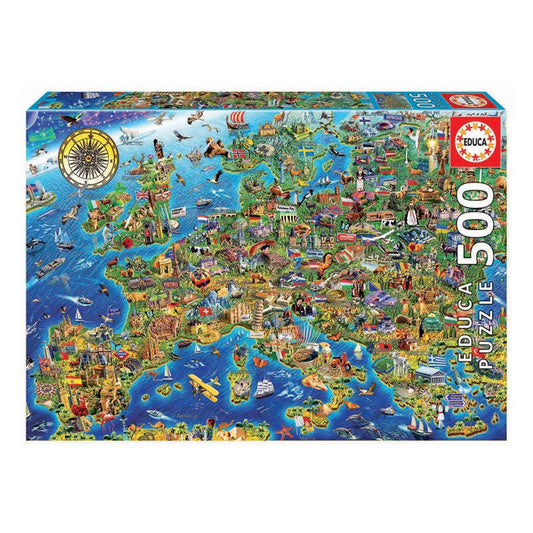
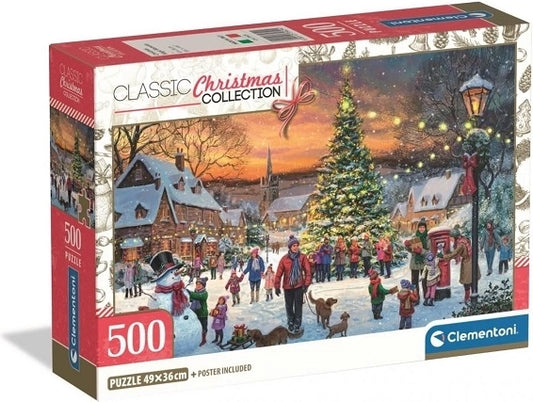
Let's do the maths with Educa. A 500 piece puzzle finishes at 48 x 34 cm; a 1000 finishes at 68 x 48 cm. Divide the area by the number of pieces and each piece is practically the same size in both. The 500 doesn't have bigger pieces: it has half as many, in a smaller picture. With Clementoni, the 500s (49 x 36 cm) and the 1000s (70 x 50 cm) work out the same.
Puzzles with genuinely big pieces do exist, but in our shop they're almost all for children: the 104 piece Maxi puzzles finish at 70 x 50 cm and each piece is close to ten times larger. The catch is that they feature dinosaurs and unicorns. Giving a children's puzzle to someone who has done puzzles all their life rarely goes down well, and it's easy to see why.
The practical conclusion is simple. For someone who already did puzzles, what helps is dropping the piece count without dropping the picture. A 500 piece puzzle with an adult photograph or illustration is done in a few afternoons and fits on a kitchen table.
Contrast: what separates an enjoyable puzzle from a frustrating one
With age, the eyes are less good at telling similar shades apart. A graded blue sky or a calm sea, already hard for anyone, turns into a wall of identical pieces. The same goes for grass, snow, dense foliage and landscapes at dusk.
Look for pictures with clearly defined areas, strong colours and straight lines: façades, windows, signs, monuments with clean outlines. Cityscapes are full of them. Trefl's 500 piece Trevi Fountain has the carved stone, the water and the statues, each with its own texture. Educa's Paris Shopping District and Clementoni's New York, also 500 pieces, come together building by building. There are more in our cities and travel puzzles collection, and we wrote about the subject in city puzzles: travelling piece by piece.
For animal lovers, Educa's Kittens with Roses combines two textures that don't get confused, fur and petals, which helps you sort the pieces from the start.
A rule that works almost every time: look at the picture on the box and mentally cover the sky. If what's left still takes up most of the image, it's a good candidate.
Pictures that get people talking
There's a reason that isn't printed on any box. A grandfather doing a puzzle of a place he has been to tells stories. The grandchildren sit beside him to listen, and end up looking for pieces.
Olivo's Images of Portugal collection is made for this, especially for Portuguese families living abroad. Yellow Façade shows sash windows, iron balconies and flower pots from old city neighbourhoods, with almost no sky: one of the best choices for weaker eyesight. Vineyards has terraces running down to the river, a landscape anyone from the Douro recognises at once. Lighthouse is lovely, but the sunset sky and the calm sea take up much of the image; save it for someone who still has the practice.
One detail to watch: the Olivo puzzles are 1000 pieces. For someone who has done puzzles all their life and still enjoys them, that's no problem, it gets done over a few weeks, at the household's pace. For someone coming back to puzzles, start with our puzzles up to 500 pieces and keep the Olivo for the second one.
We won't promise that a puzzle is good for the memory; that's for doctors to say. But it does fill an afternoon and gets grandparents and grandchildren talking without noticing.
The table, the light and the hands
A puzzle that's hard to see gets abandoned quickly. Light should come from above or in front, never from the side, because low side light casts shadows on the joins and hides the colours. Next to a window during the day is the best place. In the evening, an adjustable lamp over the table does the job.
Table height matters as much as light. Doing a puzzle on a low coffee table means hunching over for hours. A kitchen or dining table, with a chair that has a backrest, is much better.
For the hands, cardboard pieces slide less on a surface with a bit of grip than on glass or laminate. And if the table has to be cleared for meals, Clementoni's puzzle mat, 105 x 78 cm, lets you roll up the work halfway without losing anything. It's made for puzzles from 500 to 2000 pieces.
If it's a present, the puzzle can be gift wrapped (2 € on the product page) and sent straight to their home, with tracking. We ship from Portugal: up to 3 working days within Portugal, about 5 to Spain and about 7 to the rest of Europe after dispatch.