Eight or ten hours looking closely at a painting you know from books and, at the end, hanging it on the wall. That is what you are after when you buy an art jigsaw puzzle, and the painting is usually chosen before you even start browsing. That changes the question: what you need to know is how that painting behaves once it is cut into a thousand bits.
And every painter behaves differently.
Buy an art jigsaw puzzle: the brushstroke is in charge
In a photograph, two pieces of the same sky are almost identical. In a hand-painted picture, they are not. Brushstrokes leave marks with direction, thickness and small shifts in colour, and those marks tell you where a piece goes. That is why some paintings look hard on the box and go together well, and others look easy and refuse to move.
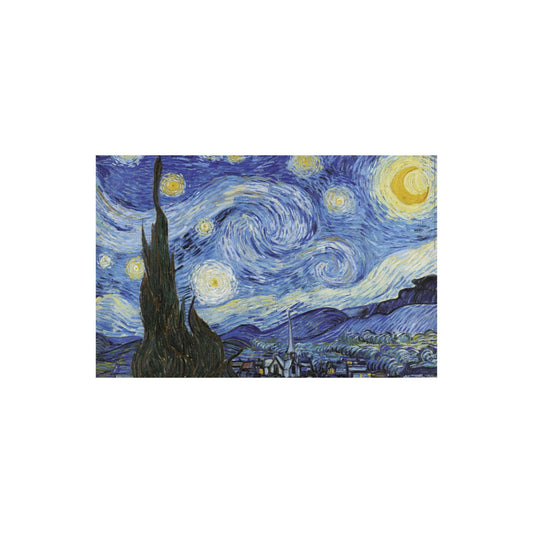
The classic case is Van Gogh. The Starry Night has blue everywhere, which is daunting, but the swirls in the sky have such a strong direction that each piece points to where it belongs. A portrait with a smooth background, painted carefully so the brush does not show, is one of the slowest things you can do.
With that in mind, here are our paintings, from the friendliest to the most demanding. It is the order of people who have seen them on the table, not a rule.
Our paintings, from friendliest to most stubborn
- Munch's The Scream, Clementoni version. The wavy orange sky, the blue fjord and the diagonal bridge are three colour areas you cannot mix up. It is the painting we recommend for a first art puzzle. It finishes at 70 x 50 cm.
- The Starry Night from Clementoni's Museum line, also 70 x 50 cm. The dark cypress and the village below take patience, but the sky moves faster than you would expect.
- Klimt's The Kiss by Clementoni. The gold is the problem: the patterns on the robe repeat and many pieces look the same. It helps to separate the gold with geometric patterns from the gold with flowers right at the start.
- Educa's Vincent Van Gogh, with two 1000 piece Van Gogh puzzles in one box. It is not harder per piece, but it is two thousand pieces in total: a good gift for a whole winter.
- Educa's Miniature puzzles, which we cover next, and which are in a different league.
All of these and more are in our art puzzles collection.
Miniature: a thousand pieces in 46 x 30 cm
Educa's Miniature series takes a famous painting and fits a thousand pieces into an area not much bigger than an A3 sheet. The pieces are tiny, and the brand itself rates these puzzles at expert level.
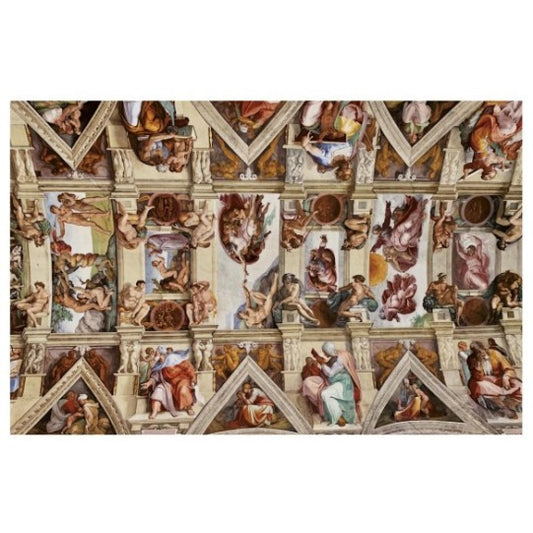
We have two, both new from Educa for 2026: The Starry Night Miniature and the Sistine Chapel Miniature, with Michelangelo's ceiling and the Creation of Adam in the centre. Both come with Fix Puzzle glue.
It is worth spelling out what that means. You need good light, ideally from above rather than from the side, because with side light the small pieces cast shadows on each other. You need good eyesight, or reading glasses within reach. And you need less table than for a regular 1000, which is a real advantage if you live in a small flat.
Also carrying the Miniatura name is Educa's Gaudí collage, which swaps painting for architecture. Check the size on the product page before choosing a frame.
Two Screams, two brands
It's easy to hesitate between the two Munch puzzles. Clementoni's finishes at 70 x 50 cm and Educa's The Scream at 68 x 48 cm, both with 1000 pieces and both for ages 14 and up. The difference lies more in each brand's board and cut than in the painting. If you already have framed 1000 piece Educa puzzles at home, the Educa one fits the same frames. It is a mundane reason, but it saves buying a new frame.
For those who prefer illustration
Not everyone who loves art wants the old masters on the wall. Ana Jarén's Despertar by Educa is a contemporary illustration with calm colours and everyday objects, at 68 x 48 cm, for those who want something quieter on the wall than a nineteenth century oil painting.
After the last piece: framing
An art puzzle is almost always one to keep, and the safest way to keep it is to glue it. The Miniature boxes include glue; for the others, buy it separately or use a glue made for puzzles. Before buying a frame, measure the finished puzzle rather than trusting the box: the sizes brands give are approximate, and a millimetre or two matters in a tight frame.
We explain the full process in our guide on how to frame a puzzle.
If you want more options in the same size, our puzzles up to 1000 pieces include landscapes and cities with the same measurements.