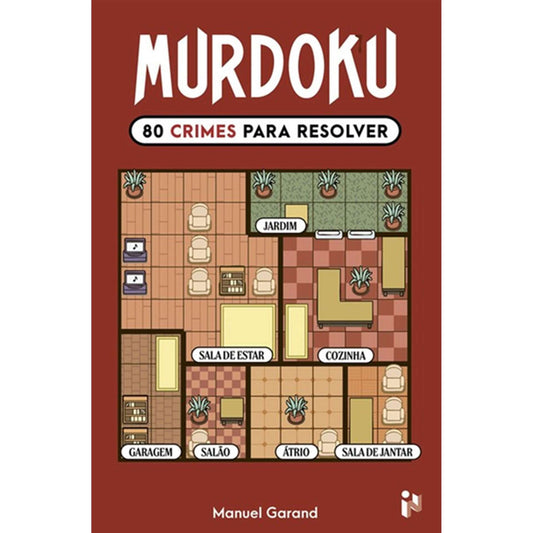
There are two kinds of Murdoku solvers: those who keep everything in their heads and those who take notes. In the first cases, both reach the culprit. In the last cases of Murdoku 3 (Portuguese edition), only the second get there without starting over three times. Marking up well is a technique like any other, and it can be learned.
The kit
- An HB pencil or softer. It writes well on illustrated paper and erases without leaving a mark.
- A white eraser. Coloured ones can smudge the illustrations.
- Optional: a second, light-coloured pencil. Very useful for hypotheses, as explained below.
Never pens. In a logic puzzle, the certainties of now are sometimes the mistakes of ten minutes later.
A three-mark system
Initial: certainty
When a position has been deduced, write the suspect's initial in the square. If two suspects share an initial, use the first two letters.
Small dot: possibility
In medium and hard cases, it helps to mark with a small dot and the initial the squares where a suspect could still be. When only one dot is left for someone, their position is found.
Dash: impossible
A row or column already occupied can be lightly crossed out with a thin dash, so your eye does not waste time on it again. In practice, many right positions appear because everything else has been crossed out.
In the margin, not on the grid
Some information is clearer outside the grid:
- a list of the suspects, with a tick next to each one already placed;
- the clues already fully used, lightly crossed out;
- in cases with secret identities, the possible identities, which should not go on the grid until proven.
Hypotheses in another colour
When you need to test a possibility, one of the most useful advanced techniques, write everything that follows from that hypothesis with the light-coloured pencil. If a contradiction appears, erase only that colour and the grid goes back to its previous state, with no confusion.
Keeping the book for later
Some people want to keep the book clean to lend it or solve it again. In that case, two options: photograph the page and mark it up on a tablet, or copy the grid onto squared paper, with just the rooms and the key objects. The second option has a bonus: it makes you look at the scene more carefully, which is already halfway to solving it. It is also the most practical way to play in a group, as described in Murdoku with family and friends.
The complete solving method, from first glance to final rule, is in the guide How to play Murdoku.