
Before you start: what is on the page
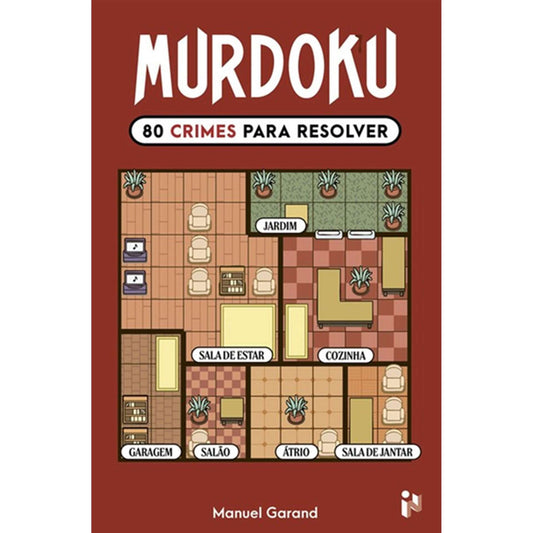
Every Murdoku puzzle has three components. First, the crime scene, a full-color illustration with rooms, furniture, plants and animals. Second, the list of suspects who have to be placed in that scene. Third, the placement rules, ending with a final rule that identifies the murderer. Knowing how to play Murdoku means knowing how to read these three parts together.
The most common beginner mistake is jumping straight to the rules without looking at the illustration. In Murdoku, the scene is not decoration: it is the game board. Before reading the first rule, it is worth spending a minute identifying what is in each area.
The rules in simple terms
Every suspect has a place
Just as every number in a sudoku has one correct cell, every suspect in Murdoku has one position in the scene. The goal is to find that position for everyone, with no contradictions. A rule might say, for example, that a certain suspect is in a room with a particular object, or that they are never next to another suspect. Each puzzle explains its own rules, so there is nothing to memorize.
Rules narrow things down, they do not decide
No single rule tells you where someone is. It is the combination of several rules that closes off the possibilities. This is what makes Murdoku a pure logic puzzle: there is always a single solution, and you reach it through deduction, never by guessing.
The last rule is the reveal
Once all the suspects are placed, the final rule tells you who the culprit is. If it points to more than one person, or to nobody, something went wrong with the placement and you need to go back.
Step-by-step method
1. Study the scene
Identify the rooms, the notable objects and the animals. Look for details that stand out: a single plant, a single painting, an animal somewhere unusual.
2. Read all the rules before placing anyone
It is tempting to pin down a suspect as soon as you read the first rule. Reading everything first lets you see which rules are the most restrictive, and those are the ones to apply first.
3. Start with what is most certain
Look for the rule that leaves only one possible position for a suspect. Mark it in pencil. Then check how that placement limits the options for everyone else. It is the same chain reasoning as in sudoku.
4. Note the impossible positions
Marking with a small dash the areas where each suspect cannot be is just as useful as marking where they can. Often the right spot appears because every other one has been ruled out.
5. Double-check before applying the final rule
Go over every rule again with your provisional solution. Only then read the rule that reveals the murderer.
Tips for leveling up
Volume 1, Murdoku, 80 Crimes Para Resolver (Portuguese edition), goes from easy to expert. In the first cases, the method above is enough. In the last ones, it helps to work with hypotheses: assume a position, follow the consequences and, if a contradiction appears, safely discard that hypothesis. A pencil and an eraser are the most important tools in the game.
Another useful tip is to solve out loud when playing with someone else. Explaining why a suspect cannot be in a certain spot forces you to state the deduction clearly and catches reading mistakes. If you enjoy verbal deduction, you will also like the Murdle series, where all the clues are written in text.
Mistakes to avoid
Confusing similar elements in the illustration. Two chairs or two plants may be different as far as the rules are concerned, so look carefully. Applying a rule too loosely, for example reading “next to” as “in the same room”. Placing a suspect based on narrative intuition, because they “look guilty”, instead of by deduction. And finally, giving up too early on a difficult case: there is almost always a rule that has not been fully explored yet.
Frequently asked questions
Do I need to solve the puzzles in order?
It is not required, but in volume 1 the difficulty increases throughout the book, so following the order helps you learn step by step.
Can I play in a group?
Yes. It works really well with two or three people over the same page, each testing hypotheses. For groups with young people ages 12 and up, it is a great family activity.
What should I do if I reach a contradiction?
Go back to the last placement you were absolutely sure of and review the ones after it. A contradiction almost always means a rule was read too quickly.
With the method in mind, all you need is the book. Start with Murdoku volume 1 (Portuguese edition) or go straight for the two-volume pack and get 160 crimes to practice on.