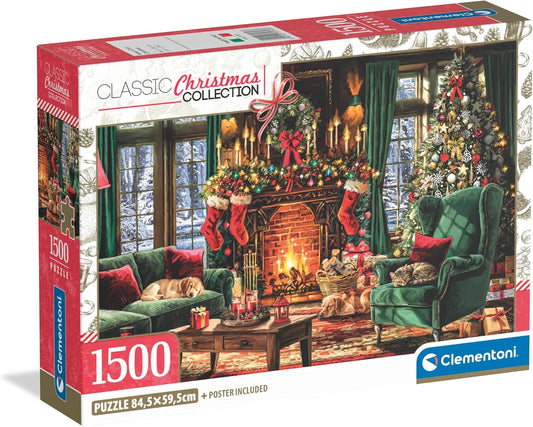
Choosing between Ravensburger and Clementoni is not just a question of brand. For many people, it is about deciding what kind of experience they want at the table: a puzzle with a very firm fit and a consistent finish, or an option that, in certain segments, manages to strike a good balance between variety, price and educational value.
Both have a strong presence in the European market and both come up again and again when people talk about puzzles, children's games and family activities. Even so, they are not the same in what they offer or in how they position themselves. When you compare them carefully, real differences appear in cut quality, image, durability, age range and even perceived value.
Direct comparison between Ravensburger and Clementoni
Before going into detail, it is worth putting the criteria that matter most when buying side by side.
| Criterion | Ravensburger | Clementoni |
|---|---|---|
| Reputation in puzzles | Very strong, especially among adults and families | Very strong, with a big presence in puzzles and a children's range |
| Quality of fit | Generally very precise and stable | Good, with slight variation between ranges |
| Image finish | Sharp, consistent print | Good visual quality, often with appealing designs |
| Variety of themes | Very wide | Very wide |
| Educational range for kids | Solid | Very relevant and often associated with learning |
| Value for money | Tends to be more premium | Often more competitive |
| Typical audience | Enthusiasts, families, collectors | Families, children, price-conscious buyers |
This table does not decide the purchase on its own, but it helps frame an important idea: Ravensburger tends to be seen as a more premium benchmark in puzzles, while Clementoni usually stands out for the breadth of its range and a very appealing balance between cost and offer.
If your priority is very clear, the decision becomes simpler:
- fit and consistency
- more affordable price
- educational range for kids
- puzzles to give as gifts
- collecting
- variety of licenses and images
Puzzle quality: where the difference is usually felt
When it comes to Ravensburger vs Clementoni, puzzles are where the comparison gets most interesting. This is where many buyers notice the differences right away, even without looking at the box.
Ravensburger has a very solid reputation for how its pieces are cut. The fit is usually firm, the thickness of the cardboard feels sturdy and assembly tends to feel “cleaner,” with less ambiguity between similar pieces. If you do puzzles often, this matters a lot. It reduces frustration and gives a sense of precision that becomes addictive.
Clementoni, for its part, also offers a very good level of quality, especially in well-established ranges. In many cases, the print quality is convincing, the images are rich in color and the overall experience is positive. Even so, some more demanding puzzlers notice somewhat more variation between collections or print runs, something Ravensburger usually controls better.
Fit, cut and durability of the pieces
The fit is not an unimportant technical detail. It is one of the elements that most defines the pleasure of building a puzzle.
When the pieces slot in nicely, without too much play, the puzzle feels more stable and the work flows better. You notice this in 500-piece models as well as in larger formats. If you like moving assembled sections around the table, a firm hold is almost essential.
In practice, many buyers value these signs of quality:
- Precise cut: fewer near-identical pieces fooling the eye
- Thick cardboard: a feeling of durability and good resistance to wear
- Well-applied image: less excessive glare and less loss of detail
- Even finish: lower chance of small irregularities between pieces
On this point, Ravensburger starts with an advantage in the general perception of the market. That does not mean Clementoni is far behind, but rather that the German brand is usually the safest choice for those who put the mechanical quality of the puzzle above everything else.
Image quality and visual variety
There is another very relevant criterion: visual enjoyment. A puzzle can have a good fit and still fail to excite.
Clementoni really stands out for the diversity of its images, including landscapes, art, cities, pop culture and very accessible family designs. If you buy based on the look of the illustration or an emotional connection to the theme, this breadth is a clear advantage. The brand manages to speak to very different audiences.
Ravensburger also offers a vast catalog, but it tends to convey a more consistent sense of curation and finish. In many cases, the final image feels very well balanced in contrast, sharpness and readability in the hardest areas. If you value a stimulating challenge without unnecessary visual noise, this can make a difference.
Ravensburger and Clementoni in educational toys
The comparison is not only about puzzles. Both brands also find their way into homes through children's games, creative kits and educational products.
Here, Clementoni tends to gain visibility more easily. The Italian brand has built a strong association with the educational world, especially for younger ages. Many parents come across the brand in games about letters, numbers, visual matching, science for kids and early logic activities. It has a very clear identity of hands-on learning.
Ravensburger, although it also has a strong children's and family side, is often remembered for games of consistent quality and for an approach that mixes entertainment with skill development. Rather than feeling purely school-like, its offer tends to come across as broader, with a strong presence in games to share as a family.
For young children, which brand makes more sense?
It depends a lot on the goal. If the priority is early cognitive training, visual recognition, language or discovery activities, Clementoni often comes up as the natural option. Its children's catalog is wide and fits well with the idea of playing and learning at the same time.
If the intention is to buy something that will last longer in the family routine, with a sturdy finish and a very stable user experience, it is worth comparing specific ranges, such as the kids' puzzles from Clementoni, Educa and Trefl. It is not just a question of “being better”; it is a question of how it will be used.
There are scenarios where each one tends to fit better:
- Clementoni: early learning stage, educational variety, purchases on a set budget
- Ravensburger: family games, frequent puzzling, seeking premium consistency
- Clementoni: children's gifts with an educational component
- Ravensburger: repeated use and a greater focus on finish
Price and value for money: which is more worthwhile?
Price should rarely be looked at in isolation. What matters is the value delivered for every euro spent.
In many stores, Clementoni appears at more attractive prices, especially in children's ranges and in certain widely sold puzzles. This makes the brand particularly interesting for regular purchases, for those who want to try different themes or for families who prefer not to invest as much in a first purchase.
Ravensburger is usually positioned slightly higher. That difference tends to be accepted by those who already know they enjoy the brand's experience and want to minimize the risk of disappointment. When the goal is to buy less but buy very well, it is also worth comparing the adult ranges from Clementoni, Educa and Trefl before deciding.
This leads to a simple distinction: Clementoni usually wins on accessibility; Ravensburger usually wins on confidence in the finish.
User experience: what changes in practice
The spec sheet helps, but what stays in your memory is the real experience. And that is precisely where this comparison stops being abstract.
With a Ravensburger puzzle, it is common to feel a more stable assembly, a predictable cut and a very controlled print. This keeps your attention on the challenge of the image, not on doubts about the piece. For many enthusiasts, that difference is enough to prefer the brand almost automatically.
With Clementoni, the experience can be very satisfying, especially when the theme is strong, the price is right and the puzzle serves as a moment of easygoing leisure. In a family setting, or for those who switch between different activities and do not make puzzling a regular habit, that flexibility is a virtue.
A smart purchase comes down to answering a few simple questions:
- Will it be used often, or is it a one-off purchase?
- Is the priority the finish or the price?
- Does the person using it value challenge, learning or visual variety more?
- Is the product for yourself or a gift?
Ravensburger vs Clementoni for different types of buyer
Not everyone is looking for the same thing. That is why the question “which is better?” always needs a follow-up: better for whom?
For puzzle enthusiasts, Ravensburger usually has the edge. The consistency of the fit, the sturdiness of the pieces and confidence in the experience put the brand on very safe ground. Those who build puzzles regularly, keep their boxes, come back for more and pay attention to technical details tend to notice these differences.
For families with young children, Clementoni can be extremely convincing. Its educational range is wide, the brand is available in many stores and the prices make it possible to build a small collection without much effort. That creates accessibility and continuity.
For gifts, both work well, but in different ways. Ravensburger more easily conveys an idea of premium quality. Clementoni offers more freedom to match theme, age and budget.
Availability, catalog and the buying decision
A less discussed but very practical criterion is how easy it is to find each brand. Depending on the store, the time of year and the category, one may be more prominent than the other. This influences the decision more than it seems.
Clementoni often benefits from a very strong presence in the children's and educational segments. Ravensburger maintains a very solid image among benchmark puzzles and family games that have been on the market for a long time. When a shopper is looking for something specific, this difference in distribution can weigh as much as product quality.
There is also an emotional side. Some people feel more confident with a brand they have known since childhood. Others prefer to try and compare within the same budget. Both approaches are valid, as long as the purchase is guided by real use and not just by how famous the name on the box is.
What to check before choosing between Ravensburger and Clementoni
Before buying, it is worth looking beyond the brand. The specific range, the piece count, the recommended age and the type of use all count for a lot.
For an adult puzzle, pay attention to the quality of the fit, the sharpness of the image and the type of visual challenge. For a children's toy, what matters is whether the product is too simple, too school-like or truly suited to the child's stage of development.
If you are buying online, reading recent reviews helps you understand the building experience, the durability of the pieces and overall satisfaction. The brand alone does not always settle everything. In certain ranges, the context of the product matters more than the overall comparison between manufacturers.
When the priority is puzzle quality in the strict sense, Ravensburger often comes out as the stronger choice. When the focus is on the balance between price, variety and educational products, Clementoni is very hard to ignore. In the end, the best answer lies not in the rivalry between names, but in how well the product fits the way it will be enjoyed.
At Loja dos Puzzles you'll find Clementoni puzzles as well as puzzles from Educa and Trefl, so you can choose the right puzzle for every profile.