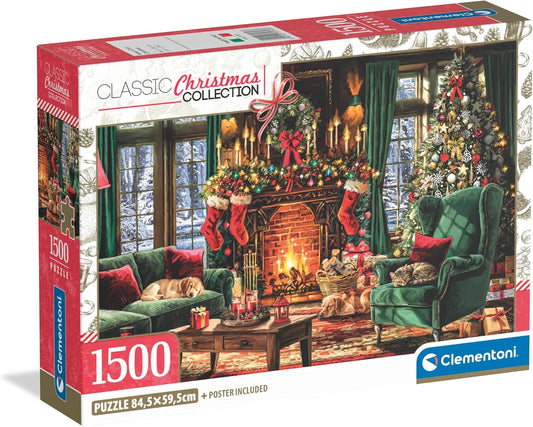
When it comes to activities that combine learning, concentration and quality time, puzzles still hold a very solid place. And among the most popular brands, Clementoni often shows up in the choices of families and educators.
The short answer is simple: yes, Clementoni puzzles can be a good option for kids. The more useful answer, however, calls for a closer look at age, piece count, type of illustration and the child's personality. A good puzzle is not just “pretty” or “popular.” It has to suit the child's stage of development, be challenging enough and, at the same time, be accessible.
Why puzzles are good for kids
Puzzles work on several skills at once without feeling like schoolwork. The child observes, compares, tests ideas, corrects what does not work and keeps going until a solution is found. This process has value in itself.
There is also an important benefit in how the child learns to deal with frustration. Not everything fits the first time. Not every attempt works. Even so, the goal remains visible and concrete, which helps them persevere.
In a well-chosen context, puzzles support:
- hand-eye coordination
- sustained attention
- visual perception
- spatial organization
- tolerance of mistakes
For many kids, this becomes a calm and rewarding exercise, far from the fast pace of screens.
Assessing the quality of Clementoni puzzles for kids
When you ask whether a Clementoni puzzle is a good buy, product quality matters a lot. In general, the brand has a good reputation in the children's and family puzzle segment, especially for the variety of its ranges and its careful visual presentation.
In models designed for kids, it is common to find pieces sized for small hands, colorful images and appealing themes. This helps a lot with the building experience. When the illustration is clear and the cut of the pieces is consistent, the child runs into fewer unnecessary blocks and feels more eager to keep going.
Another relevant point is durability. With tabletop toys, durability counts. Pieces that are too thin and bend easily, or poorly defined fits, can make the activity less satisfying. In many Clementoni puzzles, the cardboard usually feels sturdy enough for regular use, although this can vary depending on the range and age group.
It is also worth looking at the print quality. Bright colors, visible contrasts and recognizable elements help the child find their way. This may seem like a small detail, but it changes the experience a lot, especially for younger ages.
Cognitive benefits of Clementoni puzzles in childhood
Not all educational toys manage to be truly engaging. Puzzles have that rare advantage: they teach without needing to feel like a lesson. And when the visual design is well thought out, as it is in many of this brand's children's puzzles, the educational potential grows.
The child learns to separate edge pieces, identify patterns, group by color and test the relationship between shape and image. They are building analytical reasoning, even if they do not call it that. At the same time, they train visual memory and attention to detail.
There is a less discussed and very valuable aspect: puzzles help regulate a child's inner pace. They require pausing, focus and time. In a daily life full of fast stimuli, this active slowness can be very healthy.
The most common benefits include:
- Fine motor skills: picking up, turning and fitting pieces with precision
- Visual reasoning: recognizing patterns, outlines and spatial relationships
- Independence: making progress through trial and error without always relying on an adult
- Self-confidence: feeling concrete progress until the image is complete
When the activity is well matched to their age, children realize they can solve problems on their own. This has a very positive effect on how they approach other challenges.
What age is right for Clementoni puzzles
The question of the right age is perhaps the most important one. An excellent puzzle can be a poor choice if it is too complex. And a puzzle that is too simple loses its appeal within minutes.
The good news is that there is a wide variety of formats. This makes it easier to choose for different stages of development, from preschool to older kids who are already looking for detailed images and higher piece counts.
The following table can serve as a practical reference.
| Age group | Recommended piece count | Most suitable type of image | Level of adult support |
|---|---|---|---|
| 3 to 4 years | 6 to 24 large pieces | animals, vehicles, simple characters | close support |
| 4 to 5 years | 24 to 48 pieces | clear scenes with few distractions | moderate support |
| 5 to 7 years | 48 to 104 pieces | favorite themes, distinct colors, easy-to-read backgrounds | occasional support |
| 7 to 9 years | 104 to 200 pieces | more detailed images and rich compositions | little help |
| 9+ years | 200+ pieces, depending on the child | landscapes, fantasy, detailed illustration | growing independence |
This chart does not replace observing the child. Some 5-year-olds have enormous visual patience, while some 8-year-olds prefer short challenges. The age on the box is a guideline, not a strict rule.
How to choose the right puzzle from the brand's range
Choosing well is half the battle. The other half lies in how the puzzle is introduced and supported. If the child opens the box and immediately feels it is “too much,” the experience loses its impact.
Start with the child's real interests. A puzzle featuring dinosaurs, oceans, princesses, superheroes or farm animals can win them over instantly. The theme is not a decorative detail. It is what drives motivation.
Next, look at the visual complexity. Some images have many repeated areas, confusing backgrounds or too much detail. For adults, that can be appealing. For young children, it can become an unnecessary barrier.
When choosing, it is worth checking these points:
- Piece size: comfortable for small hands and less risk of frustration
- Image clarity: easy-to-recognize elements and distinct colors
- Piece count: difficulty matched to the child's current level, not the level you want them to “train” for
- Material: firm cardboard and clearly defined fits
- themes the child already enjoys
One often overlooked detail is the space available at home or at school. A bigger puzzle needs a stable table and time to stay set up. Without that, the activity may be interrupted and lose its positive effect.
Situations where a Clementoni puzzle may not be the best choice
Saying a brand is good does not mean it is ideal in every context. There are cases where a puzzle, even a high-quality one, will not be the best option for that child at that moment.
If the child has little patience for waiting, is very tired or wants more physical play, insisting on a puzzle can create resistance. The same happens when the challenge is clearly above their current level. Excessive frustration does not teach persistence; it teaches avoidance.
It is also worth thinking about sensory sensitivity and attention style. Some children prefer more tactile materials, 3D building, blocks or games with movement. In these cases, puzzles can come later or in short sessions.
There are simple signs that help you tell whether the choice was not the best one:
- gives up after a minute or two
- constantly asks for help with almost every piece
- gets annoyed with basic fits
- shows no interest in the image
- avoids repeating the experience
This does not mean the child “does not like puzzles.” It may simply mean that particular model is not right for now.
Clementoni puzzles and quality time between adults and kids
A puzzle is rarely just an object. It often becomes a reason to spend time together without pressure, without screens and without the need to produce quick results. That has educational and relational value.
Building a puzzle with a child calls for a discreet presence. It is not about doing it for them, but about being available. An attentive adult can guide the child's eye, suggest sorting by colors or edges and, at the same time, leave room for the child to test ideas.
This involvement is especially useful in the first experiences. The child gains visual vocabulary, learns strategies and understands that making mistakes is part of the process. Over time, the support can be reduced.
A good practice is to turn the puzzle into a small calming ritual. Ten or fifteen minutes on a regular basis can work better than a long, demanding session. The pace matters as much as the choice of product.
Safety, materials and supervision when using children's puzzles
With toys aimed at children, safety must come before any other criterion. Even when the brand is well known, it is still important to check the indicated age range and the size of the pieces.
For young children, very small pieces can pose a risk. It is also worth checking that the cardboard does not shed too many fibers after little use and that the box stays in good condition for storage. A safe activity starts long before playtime.
Some simple precautions make a difference:
- Indicated age range: follow the recommendation on the packaging
- Initial supervision: especially during the first uses or at younger ages
- Building space: a clean, stable surface with good light
- Storage: keep all the pieces together to avoid losses and future frustration
When the environment is well prepared, the child concentrates better and gets more out of the experience.
Is a Clementoni puzzle worth buying as a gift?
As a gift, a puzzle has a clear advantage: it combines entertainment with lasting value. It does not need batteries, it does not lose its appeal in a single day and it can be done again and again, especially at younger ages.
The brand usually has visually appealing options for various age groups, which makes it easier to find a model that matches the child's tastes. Even so, giving “a pretty puzzle” is not enough. The best gift is the one that fits the specific profile of the person receiving it.
If you are unsure between two difficulty levels, the safer choice tends to be the slightly simpler one, as long as it is not too babyish. Enthusiasm comes from a sense of progress, not from maximum difficulty.
A well-chosen puzzle can be one of those gifts that stay with you. First as a game, then as a memory of independence won piece by piece. And that is where the opening question gets a more solid answer: yes, it can be a very good option for kids, as long as the choice is made with care, attention to age and respect for each child's own pace.