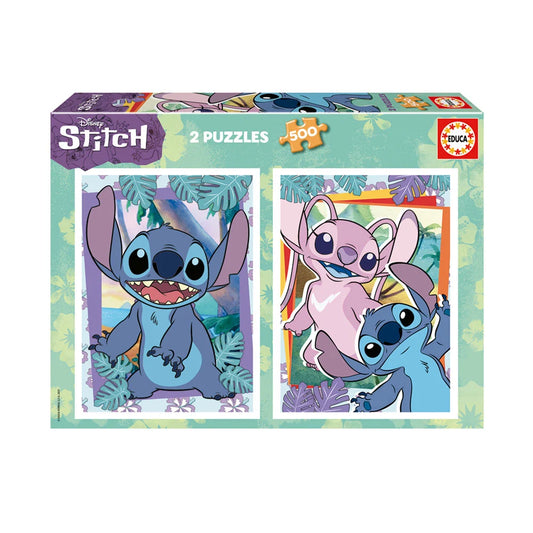
Some toys keep the hands busy and free the mind. A good puzzle does all that and also brings kids and grown-ups together around the table. If the theme is Stitch, the energy changes instantly: color, humor and a dash of lovable mischief. The Clementoni set of 3 puzzles with 48 pieces brings together three different images, each with its own charm, in a format designed for children who have already mastered the basics of puzzling and are asking for a challenge with a bit more substance.
It's a compact choice, well suited to anyone who wants to start a puzzle routine at home without filling the living room with boxes. And it's also a great gift idea.
What this Stitch set includes
We're talking about three different puzzles, each with 48 pieces, made of thick cardboard with precise cuts. Each image features an illustration of Stitch in colorful settings, with elements that are easy to identify by area, which helps children organize their building.
Three images, three stories. The same number of pieces, but different challenges, varying in how the colors and reference elements are distributed. This avoids monotony and invites children to come back to them day after day.
Once assembled, each puzzle is a practical size for the kitchen table or an activity mat. It doesn't take up too much space, but it's big enough to give that feeling of a “finished masterpiece”.
Here's a technical summary to help you choose:
| Feature | Detail |
|---|---|
| Brand | Clementoni |
| Series | 3x48 pieces (Disney Stitch licence) |
| Contents | 3 different puzzles, 48 pieces each |
| Recommended age | Ages 4 to 5 and up, depending on the child |
| Approximate size per puzzle | About 32 x 22 cm |
| Material | Sturdy cardboard with a precise cut |
| Bright colors and sharp images | |
| Goal | Hand-eye coordination, spatial reasoning, attention |
Why 3x48 pieces makes sense
At this stage, many children can already complete puzzles of 24 or 35 pieces with ease. Moving up to 48 pieces adds a layer of reasoning: more fragments of color, more attention to outlines, more time spent concentrating. It's a natural step up, without going overboard.
The 3x48 format has another important advantage: each session can be short. You assemble one puzzle in the late afternoon, put it away, and look forward to doing the other two the next day. The feeling of progress comes often, and that fuels motivation.
All this without losing the playful side. Stitch sparks conversation, invites comments and jokes while puzzling, and offers plenty of material for made-up stories as the pieces fall into place.
One little piece at a time. And confidence grows.
Clementoni quality, inside and out
The Italian brand has a long tradition of educational and family puzzles. The cut is clean, the pieces fit firmly and the print is consistent, with colors that stand up well to light and repeated handling.
Another point that usually pleases people buying for children: the thickness of the cardboard. It's not so rigid that the tips chip, but it doesn't bend easily either. It can handle curious hands that are still learning to “measure their strength”.
There's also a visible commitment to safe materials and responsible processes. That's where its reputation for durability comes from, which for many parents is crucial when thinking about passing the game on to younger siblings or cousins, or even donating it to a school.
How to guide the puzzling in a relaxed way
A good puzzle calls for a method, but it doesn't need to be rigid. Start by building the habit, without turning the activity into a test.
- Pick out the corner and edge pieces, build the frame and create “islands” of color inside.
- Sort the pieces by the main elements of the image: characters, background, repeated details.
- Adjust the difficulty: fewer pieces on the table at first, more pieces in view once your child feels confident.
After a first approach, it's worth introducing small strategies that boost focus and independence.
- Light: working with light from the front and without glare helps tell similar shades apart.
- Surface: using a felt mat or a rigid board prevents lost pieces and makes it easy to tidy up without taking the puzzle apart.
- Breaks: short breaks, before frustration sets in, keep the enthusiasm alive for the next day.
- Ritual: always starting with the same step is comforting and makes getting started faster.
- Language: saying colors and shapes out loud (“I'm looking for dark blue with a curve”) reinforces visual clues.
Game ideas beyond the obvious
There are many ways to keep a puzzle fresh when you do it again. Some are instant and change the energy of the session right away.
- Race against the clock
- Puzzle in silence and only talk at the end
- Puzzle to the soundtrack of the movie
- Take turns: one piece per person
- Hunt for corners and edges, with points
- Switch “islands” every two minutes
One simple rule per session is enough. The goal is to add variety without distracting.
Learning that sticks, even when no one notices
The effects are subtle but consistent: spotting patterns, anticipating fits, handling frustration and celebrating small victories. These are skills that have a positive impact on other areas, from reading images to organizing tasks.
The theme matters too. Stitch is a friendly go-between who almost always brings a smile. That light humor holds attention for longer and creates an emotional context that supports learning.
Little by little, children start looking at a piece and “seeing” where it might fit without trying eight different spots. That's intuition growing out of practice.
Organization and care: how to make it last
Storing it well is half the battle when it comes to playing again without surprises. Each puzzle has its own visual identity, but when everything goes back into the same box, chaos quickly sets in. There are simple ways to avoid that.
A classic solution is to separate the pieces of each image into zip bags, labeled by the color of the illustration or with a small sticker. Another option is to discreetly mark the back of the pieces with a tiny sign for each puzzle, using a different colored pencil for each set. It's reversible and doesn't spoil the front.
As for cleaning, a soft, dry cloth takes care of almost everything. If liquid is spilled, blot it dry with paper towel without rubbing and let it air dry. Never use harsh products.
If you like framing, special puzzle glue works well with this type of cardboard. Apply a thin layer with a brush, let it dry and place it in a light frame. It makes a lovely decorative piece for a child's room.
Buying wisely: price, versions and authenticity
There are many Stitch editions on the market, and prices vary depending on the season, availability and store. It's a good idea to check that the box clearly says “3x48” and that the images on the front match the three illustrations included.
The price is usually affordable for a set of three, but it's worth comparing physical and online stores. During seasonal campaigns, discounts come up frequently.
If you're buying online, check reviews, real customer photos and, if possible, the return policy. A box showing signs of repackaging isn't necessarily a problem, but it should arrive complete and with no warped pieces.
Quick sessions that fit into your day
There isn't always time for a whole afternoon of play. Here, 10 to 20 minutes is enough to feel progress. Once learned, a 48-piece puzzle can be assembled at a calm pace during a snack break.
This format encourages regularity. Several short sessions a week do more than an occasional “marathon”. The child keeps a positive relationship with the activity, and the adult doesn't feel they need to block out time in the calendar for it to be fun.
If there are siblings of different ages, the dynamic can be adapted. The younger one looks for edges and brightly colored pieces, while the older one guides and checks the trickier fits. Nobody is left out.
Quick questions
After a few rounds of puzzling, some common questions come up. We've gathered short answers to help you decide faster.
- Is it hard for a 4-year-old?: it depends on their experience, but with support and a method it usually works very well.
- Do the three images have the same difficulty?: not exactly; the distribution of colors changes the challenge, and that's good for variety.
- I lost a piece. Now what?: search the work area and the floor right away; if it's really missing, you can still assemble almost the whole puzzle and keep up the habit without any drama.
- Can I take it on a trip?: yes, using a pouch or a rigid A4 folder with an elastic band to carry the separated pieces.
- Do the pieces get mixed up easily?: you can avoid it with individual bags and simple labels; it saves time in the next session.
When the puzzle inspires other activities
Once the third image is finished, the fun doesn't have to stop. There are several ways to extend the Stitch theme into other areas without much preparation.
You can suggest a free drawing inspired by the three puzzle scenes, asking your child to describe out loud what they're drawing. Or create a little “book” from stapled sheets, each page matching a stage of the puzzle, with short captions written together.
Another idea revolves around everyday math: counting pieces by type (edges vs. inner pieces), estimating how many are left, making simple charts on graph paper. All natural, in the flow of conversation.
For kids who love to move, turning the process into a “messenger” game works really well: the pieces stay on one table and the puzzle board on another, and each player carries one piece at a time, which means looking carefully before walking over.
Small details that make a difference
If the room lighting is cool, the colors can look harsher; with warm, diffused light, the image comes to life and eye strain is reduced. A simple detail.
Music also influences the pace. A calm playlist helps keep patience. A song from the movie can mark the puzzle's “entrance on stage”, creating a positive cue.
Finally, a practical tip: take a photo of the progress halfway through. Seeing how far you've come, even in a short session, reinforces the sense of achievement.
At the end of the day, a puzzle like this fits into a pleasant ritual: tea on the table, light conversation, two little hands searching for the right corner of Stitch. Tomorrow, it's on to the next image.