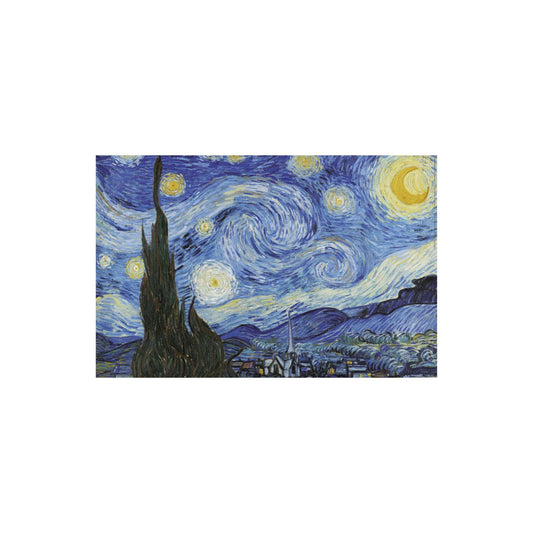
Watching a Van Gogh painting take shape piece by piece is a special feeling. The intense blues, the vivid yellows, the texture of brushstrokes you can almost feel with your eyes… it all turns into an enjoyable challenge that relaxes you and sharpens your focus. That is where the Clementoni Puzzle 1000 Pieces Museum - Van Gogh shines: it combines the pleasure of assembling with the emotion of art.
The magic of Van Gogh in a puzzle
Van Gogh's paintings were made to be seen up close. In a puzzle, that closeness becomes a method. With each piece, a swirl of color, an undulating line or a contrast of light appears and moves the whole picture forward.
Anyone who has assembled the sky of The Starry Night knows what I mean. But the same happens with the sunflowers, the almond blossoms or the bedroom in Arles. Strong areas of color and the rhythmic repetition of the brushstrokes create anchor points. It is not a puzzle that drags on. It is a puzzle that pulls you in.
What sets the Clementoni Museum series apart
Clementoni is known for its precise cut and sturdy cardboard. The Museum series adds careful printing to honor the original works. Reproducing the colors is not enough; the nuances have to be preserved without excessive gloss that tires the eyes.
There is also real attention to how the pieces feel in your hands. Pieces of consistent thickness, a clean fit, very little factory dust. All of this helps keep the table tidy and your focus on what matters.
- Precision cut: pieces with crisp edges and a firm fit, with no gaps
- Faithful printing: saturated colors and smooth gradients that respect the original
- Semi-matte finish: fewer reflections, easier to read the details
- Recycled cardboard: responsible materials with no loss of quality
- Reference image on the box: a clear picture for visual support while you assemble
Details that count
When the reproduction of the artwork is good, the clues multiply. Those small touches of lighter paint around a star or the almost imperceptible variation between two shades of blue are valuable guides. This is where the printing of the Museum series makes a difference: it gives your eye the material it needs to decide.
The edges of the painting, for example, help you identify the structure of the composition. In a Van Gogh, the direction of the brushstrokes changes often, and that pattern is readable when the definition is sharp. Every small shift in color is an arrow pointing the way.
Useful specifications
Below is a practical summary to help you plan space and time. Values may vary slightly depending on the edition, but they are a solid reference.
| Feature | Detail |
|---|---|
| Number of pieces | 1000 |
| Assembled size | Approximately 69 x 50 cm |
| Line | Museum Collection |
| Finish | Anti-glare semi-matte |
| Paper and cardboard | Responsible sources, recycled content |
| Printing | High definition, rich colors |
| Recommended age | 12+ |
| Accessories | Poster or reference image in the box |
Getting ready to assemble
A good surface, consistent lighting and a storage box for sorting pieces by category make all the difference. If you can leave the puzzle on a rigid board, you gain the flexibility to move it without taking it apart.
Create a small starting ritual. Open the box, take a quick look at the reference image and pick a simple goal for the first section. That early sense of progress gives you motivation for the rest.
- Sort the edges: straight lines first, no rush
- Create islands of color: blues, yellows and greens in small groups
- Group sister textures: curved brushstrokes, diagonal lines, small dots
- Switch tasks: edges when you want flow, the center when you want a challenge
- Check the light: avoid harsh shadows that hide nuances
Strategies for Van Gogh's colors and patterns
Van Gogh is synonymous with lively brushwork. In the swirling skies, look for sequences of curves that repeat, as if you were drawing a family of waves. Pieces that show two or three brushstroke directions in the same area usually belong to transition zones between swirls.
In the sunflowers and the almond blossoms, the petals and branches create lines that guide the eye. Put the structural elements together first and then fill in the background. A small trick: line up the micro-grooves of the print across 3 or 4 pieces to check whether the direction stays consistent.
In the bedroom in Arles, the perspective gives you a very clear map. The edges of the furniture and the outlines of objects work like tracks. It is worth setting aside 15 minutes to read those diagonals before diving into the colors.
Pace and time
A 1000-piece puzzle like the Clementoni Puzzle 1000 Pieces Museum - Van Gogh can take anything from one focused afternoon to several evenings. It depends on your mood and the image you choose. What matters is finding your own pace. Some people prefer short, frequent sessions. Others enjoy long, immersive ones.
Try strategic breaks. Ten minutes looking from a distance gives you perspective and reveals hidden patterns. Coming back from a coffee with a fresh mind is often enough to fit five or six pieces in a row.
Quality you can feel in your hands
The fit should never be forced. If two pieces lock together without resistance but do not form a natural transition of color or pattern, do not insist. At Clementoni, the cut is designed to reduce false matches, and that saves frustration.
The texture of the cardboard affects visual comfort. The semi-matte finish avoids tiring reflections. High-resolution printing reveals micro-details that, after an hour, make all the difference to your focus and the flow of the work.
Educational and aesthetic value
Assembling a Van Gogh is not just doing a puzzle. It is learning to see. Details that go unnoticed in a quick reproduction come to life when you spend minutes on a single cloud or branch.
It is an invitation to talk about art history, color, composition and technique. With family, questions come up naturally and create moments of sharing. For study, it is an interesting aid: careful observation, patience, visual memory.
Tips to keep the project in perfect shape
After a few hours, the table can fill up with small piles of pieces. A quick reorganization clears the ground and restores your concentration. Zip bags or shallow trays for colors and textures work better than large piles.
- Maintenance routine: wipe away crumbs, reorganize groups, shake the dust off the mat
- Stopping point: leave an area half finished so you can restart faster
- Side lighting: a soft lamp to reveal relief without creating glare
- Reference nearby: poster open, but not right in front of your eyes, so you have to observe
Frame it or reuse it?
Once the puzzle is finished, there are two options worth considering. Keep it to assemble again, or glue it and frame it. A Van Gogh on the wall, even as a puzzle, is a guaranteed conversation starter. And a puzzle you keep lets you relive the process in another season, in another home, with other company.
If you choose to glue it, use a glue made for puzzles. Apply a thin layer with a soft spatula and let it dry on a flat surface. If you prefer to keep it reusable, a sheet of felt or parchment paper between the puzzle and the box lid protects the assembled puzzle temporarily, in case you want to move it around the house.
A gift that creates memories
Giving a Clementoni Puzzle 1000 Pieces Museum - Van Gogh is giving quality time. It comes in a format that impresses without intimidating and delights anyone who loves art. It works well under the tree, for a birthday or as a surprise gesture in the middle of the year.
It is also a gift for yourself. Assembling a Van Gogh at the end of the day, with music in the background, creates a mental space of active calm. There is rhythm, there are small victories, there is color.
Who this puzzle is for
It is ideal for anyone who enjoys a reasonable challenge without tipping into frustration. People who love color, texture and a dose of observation will feel right at home. For beginners, it is an excellent entry point into the 1000-piece format. For experienced puzzlers, it is a tempting break between bigger projects.
Parents and educators will find a discreet tool for training patience, focus and visual reading. Puzzle collectors get a consistent standard of quality in the Museum series.
Small problems, simple solutions
If the lighting in your space creates reflections, change the angle of the light or use a side source. If very similar colors get confusing, sort by brightness: lighter tones in one group, darker ones in another. If the cut leaves you in doubt, always confirm with the continuity of the pattern, not just the shape.
If a piece is missing, stay calm and check the box carefully. Clementoni offers customer support for replacements in many regions. Taking a photo of the puzzle with the area marked helps you communicate the request.
A possible scenario
Picture the table set, the tea still hot, the box open with the starry sky smiling from the lid. In 20 minutes, the edges are in place. In two hours, the blue swirls no longer seem daunting. On the third evening, the last piece clicks in with that satisfying fit.
The painting takes on a different presence when you assembled it yourself. It stays in the memory of everyone who took part, and that does not fit in a box. It is the kind of project that turns an ordinary late afternoon into a moment you want to repeat.