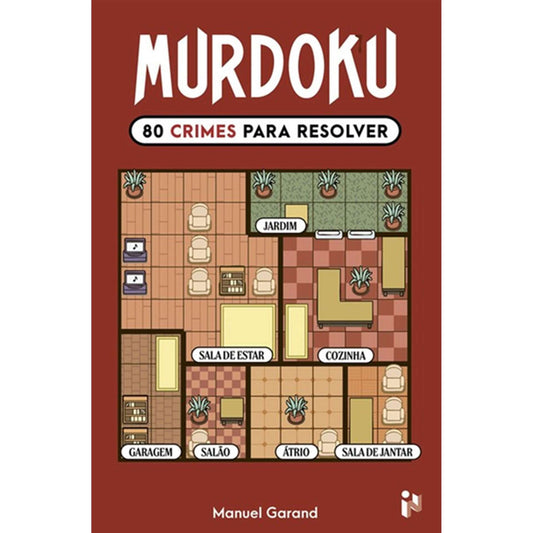
The cover of Murdoku Volume 3 works like a small map of the book. A single grid holds six places: Paris, with the Eiffel Tower; Monaco, with a driver and a racing car; Kyoto, in a room with a bonsai; Botswana, with an elephant; Fiji, by the water; and Antarctica, with a penguin. It sums up the book's promise well: 80 crimes spread across every continent.
Why the setting matters so much
In Murdoku, the illustration is not decoration. It is where the clues come from: one suspect was next to a plant, another on a chair, another in the same room as an animal. The more familiar the space, the faster you spot those elements. That is why the choice of settings changes the experience of each book, even with identical rules. The comparison of the three volumes shows that evolution.
Six places, six kinds of scene
Paris
City, landmarks and recognisable interiors. For readers coming from the earlier volumes, this is familiar ground: streets, walls, everyday objects. A good place to get back into rhythm.
Monaco
A race track changes the logic of the space. Instead of closed rooms, there are stretches of road, pits and stands. Rooms no longer look like rooms and become zones, so pay close attention to the lines that separate them.
Kyoto
Interiors with objects you would not find in a typical European home. This is where the first reading of the scene matters most: it is worth working out what each piece of furniture is before reading the clues.
Botswana
Outdoor scenes, with large animals and vegetation. When a space has no walls, the borders between areas are drawn by the terrain, and a quick glance can merge areas that are actually separate.
Fiji
Water, sand and leisure spaces. Water in particular tends to cover several squares of the grid, so it pays to check early on exactly where it starts and ends.
Antarctica
Perhaps the most unexpected setting in the whole series. Ice, penguins and lots of white: an illustration with fewer elements, where every object that does appear carries more weight for exactly that reason.
A useful habit: two minutes of observation
With such different settings, one routine saves a lot of mistakes: before reading any clue, spend two minutes just looking at the scene. Count the rooms, find the animals, tell similar objects apart. The guide How to play Murdoku describes this step in detail, and in volume 3 it matters even more than before.
No geography required
A common question: do you need to know these places to solve the cases? No. Just as the eras in volume 2 required no knowledge of history, the countries in volume 3 require no knowledge of geography. Everything you need is on the page. The destination sets the mood, and gives you a reason to turn the page. Note that the book is in Portuguese, so the place names and clues are in Portuguese too.
The full book, with its 80 cases, is introduced in Murdoku Volume 3, Around the World.