

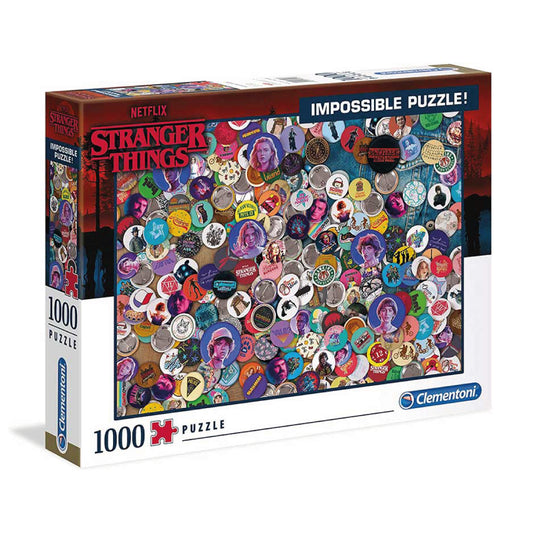
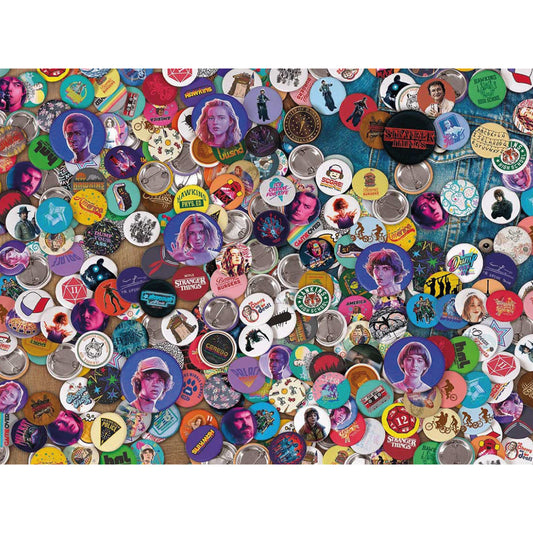


Offering a Stranger Things -inspired puzzle is a stylish way of saying, “I really thought of you.” It’s not just a package with an object inside; it’s a little experiment, full of suspense, clues, and that 80s vibe that calls for low lights, a flashlight, and a group plotting around a table.
And it has a practical advantage: the offer can be adapted to almost everyone, from those who like quick challenges to those who want to spend an entire night deciphering codes, maps, and "intercepted" messages.
What makes a "Stranger Things-style" puzzle work?
A good jigsaw puzzle has three ingredients: theme, progression, and reward. The theme captures attention from the very first piece; the progression avoids frustration and maintains the pace; the reward gives a sense of victory, even when the solution is simple.
To stay true to the spirit of the series, the experience usually works well when it mixes two worlds: the everyday (letters, cassette tapes, newspaper clippings, scribbled notes) and the unsettling (reversed messages, strange symbols, interferences, clues that seem to "not belong" to the same plane).
After setting the tone, make a decision that changes everything: will it be a puzzle to solve alone or for a small team? From there, you can adjust the difficulty, duration, and even the format of the gift.
Gift formats that feel good in the hand and in the memory.
A "puzzle gift" can be a box, a sealed envelope, a school binder, or a kit with various items. The key is to give the recipient something tangible that looks like it was found, not bought.
Before choosing the final format, think about the opening moment. Do you want it to be immediate, with a visible first clue? Or would you prefer the person to have to "discover" where to start? A discreet label, a broken seal, a note with a cryptic phrase can be enough to spark curiosity.
Here are some packaging ideas that tend to work well (without complicating production):
- Brown envelope with fake stamps and a "Notice: Confidential"
- Shoebox transformed into a filing cabinet with dividers.
- A hollow book containing a cassette tape, letters, and a folded map.
- Bag containing numbered "evidence" and an instruction card.
Types of puzzles with an 80s aesthetic (and how to make them playable)
The Stranger Things style embraces classic puzzles, as long as they're presented in the right way. The priority isn't inventing new mechanics; it's creating coherence between the clues.
After having a simple narrative (a disappearance, an intercepted message, an anomaly in a laboratory, a map that doesn't add up), choose 4 to 8 short riddles, with a final solution that unlocks the last piece of the present.
Here are a number of options that are usually easy to assemble at home and enjoyable to solve:
- Substitution cipher with hand-drawn alphabet
- Reversed (mirror) message in a "burned" clipping.
- Coordinates on a city map, with points connected by wires.
- Hunting for a number in an "old" phone book.
- Hidden word in text with intentional errors.
- A logic puzzle with contradictory schedules and testimonies.
When the recipient is solving the puzzle, what keeps their energy up is the alternation: a quick riddle, then one that requires more attention, then a visual clue. This up-and-down pattern creates rhythm and prevents the challenge from becoming monotonous.
A simple narrative is all it takes (and helps more than it seems).
You don't need to write a complex script. A premise with a clear objective is enough: "find the place," "discover the name," "unlock the tape," "open the padlock." The person has to feel that each step brings them closer to the end.
A short diagram works very well:
- an initial note justifying the kit
- a sequence of numbered clues
- a "lock" (padlock, sealed envelope, closed box)
- the final revelation, which may be the gift itself.
If you want to add texture, use language that looks like it came from a file: dates, signatures, acronyms, marginal notes. Keep it simple, but make it believable.
How to calibrate difficulty without spoiling the surprise.
The most common risk is creating good puzzles… but ones that are too difficult. A gift shouldn't become a test of endurance. The helpful rule: each puzzle should have an obvious entry point and a verifiable exit.
Think of three levels of support, without offering them immediately:
- a light tip (a guiding phrase)
- a direct hint (points to the method)
- the solution (to avoid getting stuck)
And keep these aids in a labeled "Tips" envelope, to be opened only when necessary. This maintains autonomy and avoids that moment when the experience stalls.
After determining the difficulty level, choose the desired duration. For many people, 30 to 60 minutes is the ideal range for a party setting; 90 to 120 minutes works well for a dedicated evening.
Materials, finishes and that touch of "evidence"
Aesthetics are half the charm. Aged paper, worn edges, subtle stains, and a consistent color palette make the kit look real. A well-applied detail is worth more than twenty embellishments.
After deciding on the materials, ensure legibility: clear typography, sufficient contrast, and unambiguous clues. A puzzle can look "old-fashioned" and still be easy to read.
Some elements that give the ensemble its identity, with little expense:
- Papers and textures: thick sheets, envelopes, simple adhesive labels
- Fasteners and barriers: clips, wire, fake seal, 3-digit padlock
- Signs from the “other side”: repeated symbols, ink invisible under UV light, controlled burn marks.
- Sound and nostalgia: a themed playlist in a QR code, a decorative "cassette" (even if it's just for show).
A quick guide to choosing the right type of puzzle.
The table below helps you match age, experience, and build type. It's not a rule; it's meant to help you avoid a kit that's too long or too light.
| Recipient profile | Suggested duration | Type of puzzle | Simple materials | Final reward |
|---|---|---|---|---|
| Casual curious | 20-40 min | visual codes, hidden words | 6-10 sheets, 1 envelope | final message with a direct gift |
| Fan of escape rooms | 60-90 min | Numbers, logic, combination | box + padlock, 2-3 envelopes | locked box with free gift |
| Group of friends | 45-75 min | parallel tracks, map assembly | map in parts, wires, clips | “Location” to find the gift |
| Teenager accustomed to games | 60-120 min | sequences, UV, audio | UV pen, QR code, cutouts | "mission" that unlocks an extra item |
Recommended structure: 6 steps that almost always work.
A safe way to build the kit is to think in layers. Each layer gives a piece of the story and a number, word, or coordinate. In the end, these elements come together in a single key.
After establishing the ending (what opens the padlock, what reveals the location, what unlocks the final message), assemble the path upside down.
- Define the final solution (code, phrase, coordinate).
- He creates 3 to 6 clues that feed into this solution.
- Alternate types of puzzles (text, image, object).
- Introduces a "wow" moment (UV, mirror, audio).
- Try it with someone who doesn't know the solution.
- Adjust: cut away what's excessive, clarify what's confusing.
If during the test someone says "I would never think of that," it's a sign that an intermediate clue or a clearer indicator is missing.
Gift ideas to fit at the end of the puzzle.
The ultimate prize can be material (an object) or experiential (a plan). The theme welcomes gifts that enhance the atmosphere: a game night, a retro snack kit, a book, a t-shirt, a ticket to an event.
After choosing the type of gift, think about the coherence of the ending. If the story is about "recovering an artifact," then the final object should resemble that artifact. If the story is about "locating someone," the ending could be an invitation, a note, or a photo with a message.
Some simple but effective options:
- Themed night with playlist, lights and a short "mission".
- A board game or a mini "escape game" to continue.
- Gift voucher presented as "credential"
- Home theater kit with snacks and drinks.
Personalization without falling into clichés.
The reference to the series can be subtle. Sometimes, a vocabulary reminiscent of laboratories, interference, and amateur radio, plus one or two recurring symbols, is enough. If you overdo it with familiar names and phrases, you risk turning the puzzle into a sequence of references and losing the mystery.
Personalizing effectively means including the recipient in the puzzle's logic: a place they frequent, an important date, a nickname used among friends, an inside joke. This makes the experience unique, even if the puzzles are classic.
A good technique is to create a "signature clue" that appears three times, each time with more significance. The first time it seems like decoration; the second time it raises suspicions; the third time it becomes the key.
Safety, comfort and accessibility
Some visual effects require caution. If using fire to age paper, keep the process controlled and discreet, or substitute with ink, tea, and gentle tears. If using UV light, it indicates that it should not be pointed at the eyes. If there is sound, it offers a written alternative for those who prefer it.
Accessibility is also part of good design: sufficient contrast, legible font, short instructions, and clues that don't depend on highly specific knowledge (unless that's the "gift" itself, designed for that particular person).
The goal is positive tension, not discomfort.
After the opening: how to keep the puzzle alive
A carefully crafted puzzle may not end with the final solution. If you want to extend the experience, leave room for reuse: blank cards, resealable envelopes, a file with clues to print again.
And there's one detail that's usually memorable: a short final letter, written in a human voice, without riddles. After so much deciphering, a direct sentence has an impact and closes the emotional circle of the gift, while the rest of the kit remains as an object to revisit or show to friends.