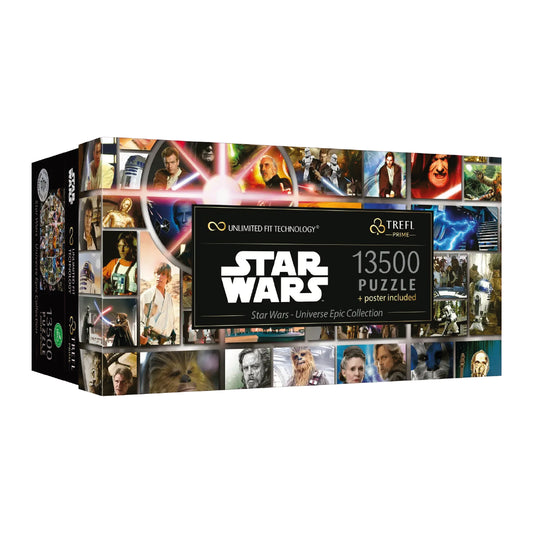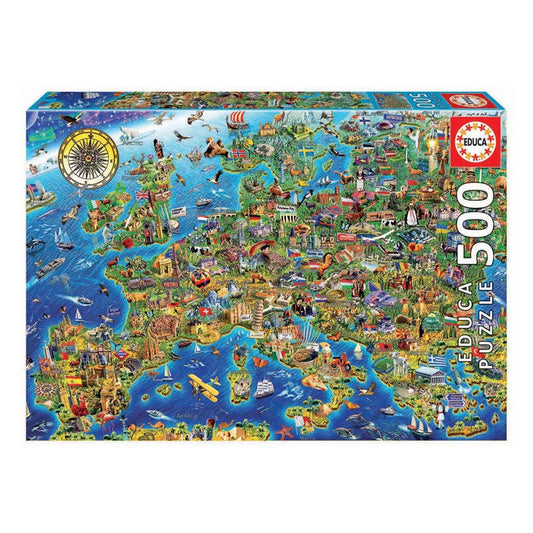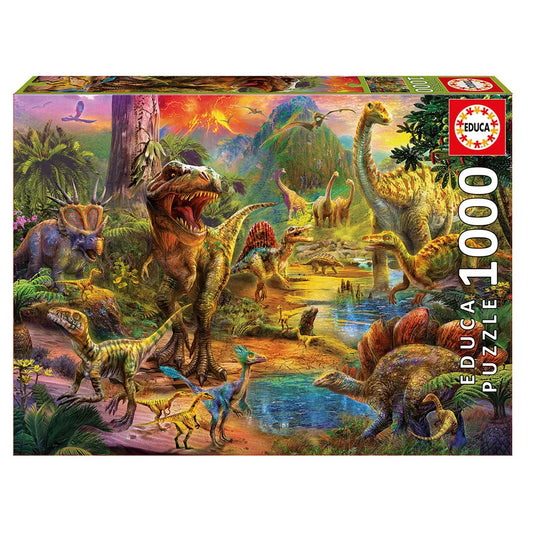





Some people see a jigsaw puzzle as a simple Sunday pastime. For many adult geeks, it's something else entirely: a territory where logic coexists with aesthetics, where a subtle reference to a favorite saga is worth almost as much as the last piece fitted.
And there is also the pleasure of "thinking with your hands." The mind makes hypotheses, tests patterns, revises strategies. The pieces fall into place and, with them, a narrative is formed: that of the process itself.
Why puzzles attract geeky minds
The appeal isn't just in the challenge. It's in the language the puzzle speaks. A good puzzle for a geek audience respects detail, rewards curiosity, and isn't afraid to be demanding.
There's a very particular kind of satisfaction in identifying a recurring motif, realizing that the color palette suggests a hidden transition, or recognizing a "modular" structure that allows you to move through blocks. It's almost like debugging code: the error is small, but the improvement is enormous when you find it.
And then there's the cultural layer. A jigsaw puzzle can be a map of an imaginary galaxy, a retro diagram of a classic console, an illustration full of internal references. The person doesn't just assemble an image; they assemble a universe.
Types of puzzles with geek DNA
Not all "difficult" puzzles are geeky. What gives them that identity is the combination of concept, design, and playability. Below is an overview of styles that tend to appeal to those who enjoy science fiction, technology, games, and pop culture, without falling into the obvious.
| Puzzle type | What makes him a geek? | Typical level | Best for | Practical tip |
|---|---|---|---|---|
| Illustrations full of references | Visual "Easter eggs," meta humor, layers of interpretation. | Medium to high | Those who like to look for details | Photograph the progress to "hunt" for references later. |
| Maps and fantastic cartography | Routes, coordinates, invented place names, grids | Average | Fans of complex worlds | It begins with coastlines and regional boundaries. |
| Pixel art and retro aesthetics | Color blocks, repeating patterns, arcade vibe | Average | Nostalgic people and gamers | Group by shades, not by "generic" color. |
| Fractals, gradients and generative art | Subtle color changes, mathematical repetition. | High | Those who appreciate patience and method. | Use cool lighting to distinguish between similar tones. |
| Mechanical and 3D puzzles | Structural assembly, functional parts, movement | Variable | Those who enjoy engineering and models. | Read the manual as if it were a "build log". |
A geeky puzzle doesn't need to be licensed by a major franchise to succeed. Often, the best ones come from independent illustrators, design studios, and publishers who treat the puzzle as a cultural object, not as a disposable product.
How to choose the right jigsaw puzzle (without falling into traps)
The ideal choice starts with a simple question: do you want to relax or do you want to be challenged? A 1000-piece jigsaw puzzle can be light and fluid, or it can be a test of endurance; it all depends on the type of image, cut, and print quality.
Another crucial point is the "behavior" of the pieces. More varied cuts reduce false connections, while very uniform cuts can create frustration, especially in areas with sky, fog, brushed metal, or monochromatic backgrounds.
Then there's the question of space and time. A large jigsaw puzzle requires a dedicated space, good lighting, and a way to pause without losing organization. This isn't a minor detail; it's part of the enjoyment.
Some practical criteria can help in deciding:
- Density of detail: more visual clues mean more consistent progress.
- Material and fit: sturdy cardboard and firm joints make assembly more stable.
- Image finish: matte reduces reflections; glossy can be tiring in direct light.
- Final size: confirm if it fits on the table and in the place where you want to store or frame it.
- Haircut style: irregular cuts tend to be more "clean" and less repetitive.
And yes, the theme matters a lot. If the image makes you want to come back to the table, you've already won half the game.
Strategies for entering the assembly "flow"
A jigsaw puzzle for adult geeks has all the makings of a ritual. There's a method to it, but there's also room for improvisation. A short session can be very productive if you start with simple preparation: a clean surface, good lighting, a tray or rigid base to move the puzzle on, and containers to separate the pieces.
The initial organization doesn't need to be obsessive. The goal is to create an environment where attention remains focused, and where each small discovery inspires a desire to continue.
A process that usually works, especially with complex puzzles, involves clear steps:
- Choose a visual "anchor" (a corner, a symbol, an area with text, a face).
- Separate items by categories (borders, repeated patterns, dominant colors).
- Build small islands and connect them when obvious transitions arise.
- Save the "cruel" areas for last (gradients, shadows, backgrounds).
- Review any questionable connections before proceeding too far.
A helpful phrase for these moments: "it's not slowness, it's precision." In generative art or pixel art puzzles, the difference between two pieces can be a single shade, and that requires patience.
Puzzles that challenge more than just the eyesight.
If your idea of a puzzle goes beyond two-dimensional fitting, there are options that are especially appealing to the geeky side: logic puzzles, puzzle boxes, mechanical models, and hybrid experiences reminiscent of escape rooms.
In these cases, satisfaction comes from another source: understanding the hidden rule. A well-designed mechanical puzzle provides immediate feedback. A box with a secret requires reading the object, paying attention to the weight, the sound, the tolerances.
There is an almost "laboratory-like" pleasure in testing hypotheses and observing results. The editing ceases to be merely visual and becomes tactile, spatial, sometimes even narrative.
And it can be surprisingly social. A difficult puzzle can bring together two people with different styles: one more systematic, the other more intuitive. Collaboration, when it's good, feels like a team solving an engineering problem.
Jigsaw puzzles as a collection, decoration, and identity.
For many geeks, the puzzle doesn't end when the last piece falls into place. The final image can be displayed, but it can also be put back in the box like someone putting away a book they want to reread.
The choice of themes says a lot. Some prefer technical diagrams, illustrations of spaceships, impossible cities, endless libraries, detailed maps, retro mosaics. Others collect by publisher, artist, type of cut, or rarity.
The important thing is that the jigsaw puzzle, as an object, manages to be both intimate and presentable. Assembling it is a private act; showing it is a gesture of sharing.
Some simple habits can help keep your collection vibrant without becoming cluttered:
- Rotate puzzles by station
- Alternate between 500, 1000 and 2000 pieces
- Saving notes on time and difficulty.
- Swap with friends who have compatible tastes.
- Reserving a "comfort puzzle" for busier days.
And if you decide to frame it, think about it from the start. A rigid base and careful handling will prevent headaches when it comes time to hang it.
Where to find good editions and how to care for them.
Quality varies widely. There are puzzles with poor printing, imprecise cuts, and pieces that fall apart after two attempts. There are also brands and artists who treat the puzzle as a design piece, with solid cardboard construction, carefully chosen color palettes, and pieces that respect the player's skill.
It's worth seeking out specialty stores, bookstores with good curation, game fairs, publisher websites, and secondhand marketplaces where out-of-print editions can be found. The used market is especially interesting for geeks because it allows them to "hunt" for rare themes, discontinued series, and illustration styles that are no longer in print.
As for maintenance, small routines make a difference: store away from moisture, avoid direct sunlight on the table, wash your hands before long sessions, and use zip-lock bags to separate pieces if the puzzle is left unfinished for weeks.
A well-chosen jigsaw puzzle can accompany you for years, changing its role according to your phase of life: sometimes a challenge, sometimes a break, sometimes a conversation starter. And when you find one that perfectly captures the theme, the cut, and the level of difficulty, the urge to start another isn't consumerism; it's the continuation of a habit that trains attention, patience, and an appreciation for detail.