

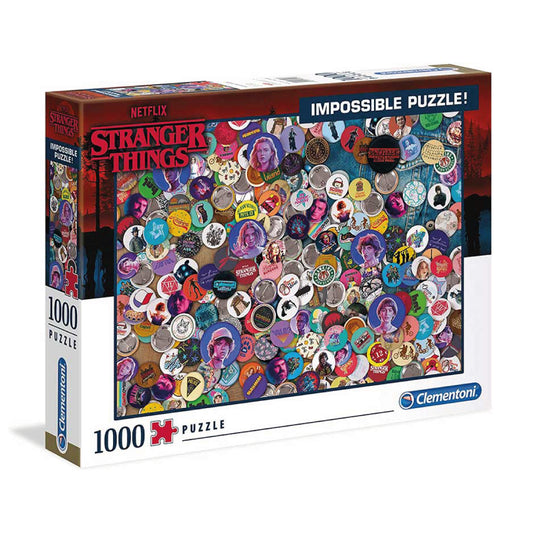
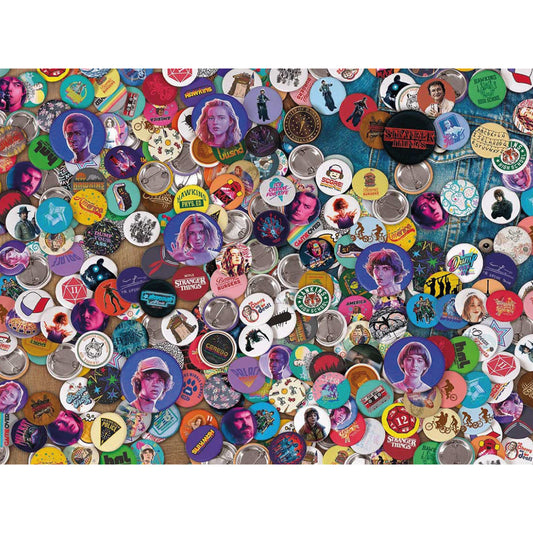


There are objects that, without making a sound, occupy the center of a room. A 1000-piece jigsaw puzzle with a Stranger Things aesthetic is one such case: it mixes nostalgia, mystery, and a dose of quiet discipline. It's not just "another" pastime. It's a ritual of attention, patience, and visual pleasure, with the added bonus of ending in an image that begs to be shown.
Those who choose 1000 pieces are looking for more than just filling an evening. You're looking for a challenge weighty enough to last for days, one that allows you to return to the board without losing track of the story, and that rewards every small victory, piece by piece.
Because 1000 pieces is the break-even point.
There are counts that hit the mark. The 500 pieces are completed too quickly when the image is appealing; the 2000 may require a long-term commitment and an almost permanent workspace. The 1000 falls right in the middle: they require method, but remain compatible with a dining table and a normal routine.
This format has another virtue: it allows you to feel frequent progress. Even on busier days, fitting 20 or 30 pieces together already "changes" the image. And when it comes to Stranger Things , this effect is especially satisfying, because the art usually has strong contrasts, hidden details, and iconic elements that appear as clues.
After a session, it's common to feel like you've accomplished something tangible. It's not forced productivity; it's active calm with visible results.
The Stranger Things aesthetic as a puzzle: what changes in the experience?
The series' visual universe thrives on neon lights, shadows, forest textures, warm-lit interiors, and that constant tension between the familiar and the strange. Like a puzzle, this translates into a curious balance: easy areas (faces, logos, striking objects) and challenging areas (dark skies, grainy backgrounds, repeating patterns).
There's also an emotional factor. Assembling a recognizable scene provides extra motivation, because each completed corner relates to a character, an episode, a phrase. The puzzle ceases to be merely geometric and becomes narrative: the image progresses and it seems as if the story "returns" to its place.
Before buying, it's worth paying close attention to the illustration style. Some editions opt for a poster with the cast and typography; others prefer a more atmospheric composition, highlighting the Upside Down. The choice greatly influences the difficulty and pace.
What usually comes in the box and what you should check.
Not all 1000-piece jigsaw puzzles are the same, even when the theme is the same. There are differences in card thickness, cut, finish, and how the image is printed. In models related to well-known franchises, it is also useful to confirm if it is a licensed product, because this is usually reflected in the fidelity of the artwork and the overall quality.
A few simple points can help avoid unpleasant surprises:
- Dense cardboard
- Matte finish
- Precise cut
- Low dust production
- Reference image included.
If the purchase is made online, the product description is not always complete. Still, there are helpful clues: the final dimensions of the puzzle, mention of "anti-reflective pieces," the presence of a poster, and an indication of the recommended age. These details help to anticipate how the assembly will be, especially with darker images.
The real difficulty: it depends more on the image than the number.
A 1000-piece puzzle can be easy or challenging, and this is almost never explained by counting alone. In Stranger Things , what often increases the difficulty is the concentration of very similar tones and extensive areas with subtle variation. The reds of the "warning world," the blacks and blues of the background, or the shadows of the forest can form "seas" where the shape of the piece matters more than the color.
To get a more practical idea, it helps to compare factors that influence effort and time. The following table is not intended to be rigid; it serves as a guide for realistic expectations.
| Factor | Easier when… | It's more difficult when… | Typical impact |
|---|---|---|---|
| Color palette | There is a strong contrast. | Dark tones predominate. | Triage time increases. |
| Image type | "Block" composition | Continuous background | It requires more attention to form. |
| Printing | Clear and glare-free | Reflections and granulation | It tires the eyes more. |
| Cutting the pieces | Variety of fittings | Many similar fittings | It increases the rate of failed attempts. |
| Available space | Wide, fixed table | improvised space | It makes it difficult to keep areas organized. |
The optimistic point is this: the difficulty is manageable. Even a dark background gives way when the method is good and when pauses are respected. And, in a theme like Stranger Things , the image itself often yields regular "rewards," because there are details that stand out and boost motivation.
Table setting: the difference between flowing and insisting
There's one detail that separates enjoyable sessions from frustrating ones: the initial organization. You don't need to be a perfectionist, but it's good to create an environment that can support setup over several days.
Good lighting does more than you might think. Ideally, neutral white light should be above the table, and if possible, a second light source to the side to reduce shadows. A solid-colored cloth or base helps the pieces stand out. For puzzles with many dark tones, a light background is often better; for puzzles with very light areas, the opposite can work.
Next comes the sorting, which can be simple and effective without taking up half an hour. Separating outlines, grouping pieces with obvious elements (typography, faces, objects), and creating "islands" is enough to gain momentum without making the process too rigid.
Assembly strategies that work well in this topic.
With Stranger Things , it's tempting to start with the characters. Often, this provides a quick and satisfying start. The risk is ending up with a set of beautiful islands, but difficult to connect because of the dark background. Ideally, you should alternate between visible progress and more technical work.
A practical approach could follow this logic:
- Draw the outline and mark the areas of dominant color.
- Build 2 to 4 strong islands (typography, face, object, light).
- Move on to transition areas, where the colors change gradually.
- Leave the large funds for phases where there are already many anchor points.
And there are little tricks that increase the success rate without making the session cumbersome. Turning pieces in the same orientation when in a homogeneous area reduces errors. Separating by type of joint (two protrusions, two joints, one of each) also helps, especially when color no longer guides the process.
When a series of failed attempts occur, the best decision is usually to stop for five minutes, change zones, and come back later. The right piece won't get away; it's your gaze that gets tired.
Assembling puzzles in pairs or in groups: the social side of jigsaw puzzles.
This type of puzzle lends itself to being a shared project. The series has a common imagery, which facilitates conversations while assembling it. And group assembly, when well managed, avoids chaos.
It works best when each person is assigned a zone and a type of task. Not as a rigid rule, but as a loose agreement, so that the table doesn't become a scramble for pieces.
Some simple agreements tend to work:
- Work zones: each person has a designated corner or tray.
- Exchange rules: "lost" items return to a central point.
- Session rhythm: short periods with regular breaks.
- Managing frustration: switching areas when one zone gets stuck.
The result is an activity that blends focus and conversation without becoming confusing. And, when the image is familiar, there's always that moment when someone fits a key piece of the puzzle and the room reacts.
Once finished: save, paste, or frame.
Completing a 1000-piece jigsaw puzzle with such a recognizable theme raises a natural question: what now? Some people take it apart with pleasure, like closing a book and returning it to the shelf. Others want to transform their work into decoration.
If the intention is to store it assembled, it's worth considering the space before applying any glue. Measuring the wall, choosing the type of frame, and deciding whether you want glass (good against dust, less good for reflections) will prevent regrets.
For those who prefer flexibility, there are intermediate options: storing them in rolls, using a puzzle base with covers, or placing them in a frame without gluing, as long as the frame presses firmly against the surface.
And there's a little-talked-about bonus: a framed jigsaw puzzle can function as a decorative piece without "screaming" fandom. It depends on the artwork chosen. Some editions have understated and elegant graphics, while others are more explosive and scenic, perfect for an office, a game room, or a reading nook.
Ideas for a session that feels like the weekend.
A puzzle like this calls for a little setting. Not out of exaggeration, but because comfort prolongs pleasure. A warm drink, soft music, and a stable table change the tone of the experience.
If you want to add a thematic touch without turning it into an event, simply choose one detail: warmer lighting in the late afternoon, an 80s-inspired playlist, or a notepad to "park" questionable items and return to them with fresh eyes.
And when the last piece comes in, the moment has something cinematic about it. Not because of the drama, but because of the clear feeling of a finished work, done with hands and time. An image that was scattered in a thousand fragments becomes whole again, and that, in itself, is worth the price of admission.