

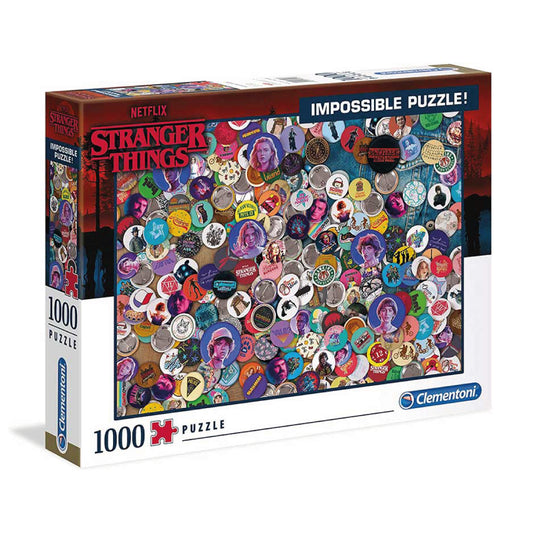
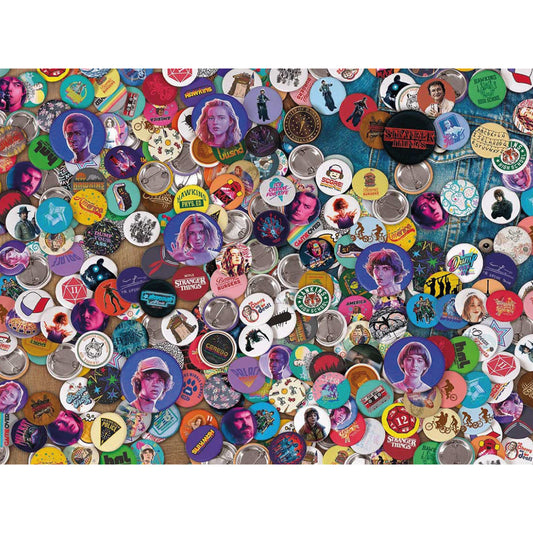


There are pop culture products that are limited to decorating a shelf, and there are others that create quality time. A Stranger Things puzzle clearly belongs to the second group: it opens up space for conversation, laughter, discussion of old theories and, in the process, building an image piece by piece.
Buying a puzzle from this series is choosing a comfortable ritual. The television provides the initial impetus, but it's the assembly that prolongs the experience, without haste and with that physical satisfaction of hearing the right "click".
Why a Stranger Things puzzle works so well
The Stranger Things universe has a rare advantage for puzzles: it's visually memorable. Neon, shadows, bicycles, forests, the "Upside Down," retro posters, maps, floating letters… all of this creates images with contrast and patterns that become enjoyable to assemble.
There's also an emotional layer. Those who followed the series recognize characters and symbols almost immediately, and this changes how the puzzle is put together. It ceases to be just "a landscape" and becomes a sequence of micro-reunions: the detail of a coat, the shape of a monster, an iconic object on the table.
And, unlike many "pretty but neutral" puzzles, there is a narrative here. Even without sound, the image suggests a moment, a conflict, an atmosphere. This helps maintain motivation when the difficult areas appear.
Choosing the right level: pieces, size and time
The right purchase is usually the most realistic one: the right puzzle for the time and patience available. A 1,000-piece puzzle might be perfect for a long weekend, but it can become endless if you only have 20 minutes a day.
It's also worth thinking about space. A large jigsaw puzzle needs a dedicated surface, preferably one where it can remain assembled without being stored away. If the living room table is "multifunctional," a roll-up mat or a rigid base might be more important than the puzzle itself.
Below is a helpful reference to help you decide without overcomplicating things.
| Number of parts | Difficulty (tendency) | Typical weather | For those who it usually works well | Observations |
|---|---|---|---|---|
| 300 to 500 | Low average | 1 to 3 hours | Families, beginners, single session | Great for gifting and starting out without pressure. |
| 750 | Average | 3 to 6 hours | Who has ever put together a few jigsaw puzzles? | A good balance between challenge and fluidity. |
| 1000 | Medium to high | 6 to 12 hours | Dedicated fans, assembly over several days. | Pay attention to the dark areas of the "Upside Down". |
| 1500+ | High | 12+ hours | Many patients, long-term project. | It requires space and organization from the start. |
One detail that helps a lot: images with many faces, text, and distinct objects tend to be more "friendly" than very dark compositions or those with large gradients.
What to consider before buying
Aesthetics matter, of course, but the experience depends on practical details. A puzzle with a fantastic image can disappoint if the pieces are fragile, if the fit is too loose, or if the finish reflects too much light.
The official license also matters. It's not always mandatory, but it usually means better printing, more faithful colors, and greater attention to visual detail. In a series so marked by tones and atmosphere, this makes a difference.
Before deciding, it helps to have a mini-checklist:
- Cardboard quality and cut : thick pieces, clean cut, little dust in the box and firm fit.
- Image finish : matte to reduce reflections; glossy for more vibrant colors, if there is good lighting.
- Type of illustration : series panel, retro poster, character collage, concept art.
- Final size : measures the table, not the intended size.
- Extra contents : guide poster, reusable bag, sturdy storage box.
A simple rule: if the goal is to relax, choose an image that draws you to the table. If the goal is a challenge, choose an image that makes you hesitate.
Where to buy with confidence (Portugal and online)
In Portugal, it's common to find themed jigsaw puzzles in large stores, toy shops, and some bookstores with a games section. The advantage is seeing the box in person, confirming dimensions, and, in some cases, comparing brands side-by-side.
Online, there's more variety and less common editions appear, including alternative art and print runs that disappear quickly. The key here is to buy from stores with a clear return policy, complete descriptions, and real photos of the packaging.
When making an online purchase, it's worth spending two minutes confirming three things: the exact number of pieces (there are versions of the same image with different counts), the final dimensions, and the language of any included text (some poster guides come with captions).
If the puzzle is a gift, the shipping and the condition of the box matter a lot. A crushed box detracts from the gift's impact, even if the inside is immaculate.
Making assembly even more fun
A jigsaw puzzle can be a relaxing solo activity, but Stranger Things calls for a group. Two or three people can naturally divide tasks: outlines, characters, letters, dark areas. And the conversation flows on its own.
Good lighting is a game-changer. Soft side lighting can create deceptive shadows; more direct light helps distinguish variations of black, blue, and purple, common in "Upside Down" images. If there's a reflection, slightly tilting the base of the puzzle can solve it.
Small habits make everything flow more smoothly:
- Separating edges first
- Group by dominant colors
- Create "islands" of characters.
- Turn all the pieces in the same direction.
- Take short breaks to avoid straining your eyes.
A puzzle doesn't need to be "finished quickly." The pleasure lies in the continuity, in returning to the table, and in the visible progress.
After you're finished: save, paste, frame.
When the last piece is added, a choice arises: to dismantle it and repeat it in the future, or to transform it into a permanent object. Both options make sense, depending on the space and its relationship to the image.
If you intend to frame it, it's worth planning ahead. Some jigsaw puzzles have non-standard dimensions and require custom frames or passe-partout solutions. The location where you'll place it is also important: direct sunlight can fade colors over time, even with a good print.
There are three common paths, each with its own "profile":
- Save for later : ideal for those who enjoy the process and want to assemble it again, perhaps with someone else.
- Paste and display : transforms the puzzle into a textured poster, great for an office or game room.
- Framing without gluing (when possible) : requires a suitable frame and a firm base, but retains the option of disassembly.
If the puzzle is to be displayed, a simple frame usually works better than a "heavy" one. The image already has enough drama; the frame should support it, not compete with it.
And if the house has fans of different ages, there's an unexpected bonus: a completed jigsaw puzzle becomes a conversation starter. Those familiar with the series find references; those unfamiliar with it ask questions; and the room gains a detail with a story, made by hand, piece by piece.