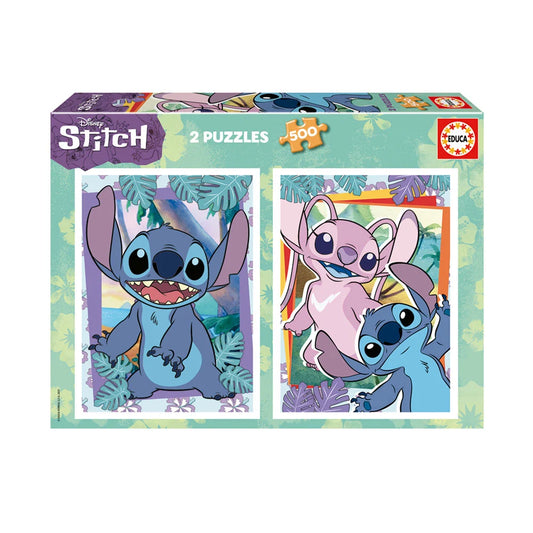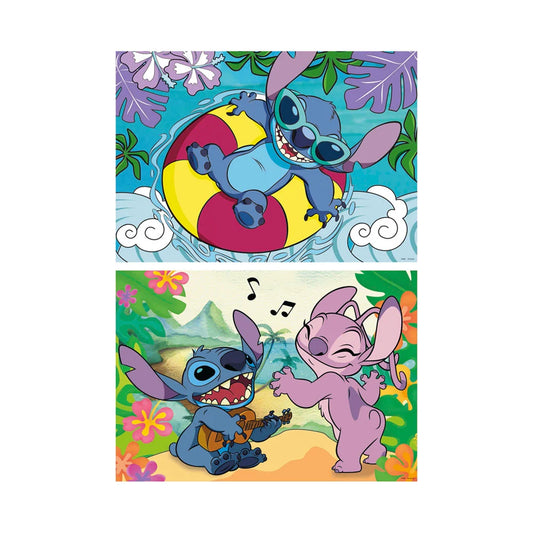
There are objects that can bring people together, quiet the mind, and at the same time awaken a playful side that we so often leave dormant. A 1000-piece jigsaw puzzle with Stitch in the center of the image is one of those objects. It combines color, humor, and a level of challenge that draws you in without being excessive. And when the last piece fits, the satisfaction is palpable.
For Disney fans, for those who love visual challenges, for those seeking a relaxing project at the end of the day, this theme makes sense. It's not just the charismatic figure of Stitch. It's the surroundings: tropical backgrounds, shades of blue and lilac, star and flower prints, gradients that demand attention and patience. And, of course, that feeling of constant progress, piece by piece.
What distinguishes a 1000-piece jigsaw puzzle?
A 1000-piece jigsaw puzzle is an interesting milestone in the hobby. It doesn't require the availability of an entire weekend, but it does require method and persistence.
- Typical dimensions: approximately 68 x 48 cm, varying slightly depending on the brand.
- Average time: between 8 and 15 hours, spread over days or weeks, depending on the difficulty of the art.
- Space: a medium-sized table or a dedicated game board, with enough space to separate groups of pieces.
- Visual complexity: sufficient to avoid monotony, with areas of uniform color requiring more careful techniques.
Unlike those with 500 pieces, repeating patterns becomes more challenging. With 1500 or 2000 pieces, the logistics get complicated. Those with 1000 pieces reach that point where you learn a lot and enjoy the process, without exhausting the patience of someone starting out.
The charm of Stitch in a puzzle.
Stitch has the kind of palette that makes for great gameplay: saturated blues, violet shadows, big, bright eyes, well-defined contours. This helps create quick, easy-to-assemble "islands," perfect for maintaining motivation. Around them, scenes emerge that break the uniformity: tropical leaves, beach postcards, starry skies, or textured prints.
Beyond the visual aspect, there's the emotional side. Those who grew up with the film recognize the features, expressions, and that mix of tenderness and chaos. A puzzle with this figure doesn't stay in its box. It sits in the living room for a few days, sparks conversation, and provides photo opportunities. And when finished, it begs to be framed.
Materials, cut and finish: what to consider before buying
Not all 1000-piece jigsaw puzzles are created equal. Manufacturing details greatly influence the experience.
- Cardboard: high density prevents warping and parts from collapsing under light pressure.
- Cutting: precision and variety of shapes reduce false fits.
- Finish: Anti-reflective matte finish makes it easier to work under strong lights; glossy varnish highlights colors, but can be dazzling.
- Printing: crisp lines and stable colors, with no deviation in image registration.
- Cutting dust: the less, the better. A bag with excess dust can dirty the table and obscure colors.
If you choose to frame a jigsaw puzzle, opt for stiffer cardstock with a matte finish. This will enhance the quality of the collage and the frame.
Quick comparison of brands and features
Below is a summary table to help you choose based on practical aspects. The values are indicative and may vary by edition.
| Mark | Approximate size | Finish | Feeling of fit | Variety of shapes | Observations |
|---|---|---|---|---|---|
| Ravensburger | 70 x 50 cm | Anti-reflective matte finish | Firm and clean | High | Stable colors, precise cuts |
| Clementoni | 69 x 50 cm | Semi-matte | Gentle and fair | Medium-high | Vibrant print, solid card. |
| Educa | 68 x 48 cm | Herb tea | Fair | Average | Lost parts service, good price/quality ratio. |
Any of these options have licensed editions with Stitch. If possible, please confirm the specific image, whether it's a minimalist cover, a tropical scene, or a collage of expressions.
Preparing the assembly area
Assembling a 1000-piece puzzle requires both visual and physical comfort. Without that, the fun diminishes.
- Light: neutral white, coming from above and from the left (for right-handed people) to reduce shadows.
- Surface: smooth, durable, and with a border. A felt mat for rolling up the puzzle is helpful if you don't have a dedicated table.
- Trays: boxes from other puzzles, kitchen trays, or paper organizers are perfect for separating by color and pattern.
- Posture: firm chair, back supported, breaks every 45 minutes. Your neck will thank you.
If you share a table with family, a portable puzzle board is a good idea. Finish your session, lift the tray, and the table is free.
Method: From the chaos of the box to the first complete island
The method isn't rigid, but following a few steps makes progress smoother.
-
Edge first
Find all the pieces with straight edges. Assemble the rectangle or sections that can already be fitted together. Having the perimeter assembled creates context and reduces unnecessary attempts. -
Sorting by color and texture
Separate obvious groups: Stitch's skin and eyes, background sky, leaves, letters, bright reflections. Even a partial sorting greatly speeds up the assembly. -
Themed islands
Start with elements that have strong outlines. Stitch's eyes and ears are often a great place to begin. Then, add adjacent areas with similar shades. -
Tactics of form
When color isn't the best choice, study the shape of the elements: "two exits and two entrances," "one narrow entrance," "long neck." In sky or water areas, form is key. -
Frequent rotation
Rotate the piece without fear. Sometimes, 90 degrees makes all the difference, and the color then matches the direction of the image's grain. -
Rule of three tests
If a piece doesn't fit after three attempts at plausible points, it goes back to the tray. This avoids stubbornness and worn-out corners. -
Smart breaks
Stop when everything seems the same. When you return, your mind notices transitions and nuances that previously went unnoticed.
Some people like to assemble it starting from the center. With Stitch, this works well because the main figure provides strong clues. If you follow this approach, keep the islands movable by assembling them on parchment paper or acetate sheets to move them later.
Tricks for difficult areas
Certain areas test your patience: starry skies, almost uniform blue shadows, smooth gradients. Here are some strategies to help:
- View the image as blocks of light, not just color. The transition from light to dark is best shown under side lighting.
- Using the back of the pieces: the card pattern may differ in small marks or the direction of the fibers.
- Create micro-series by shape: align 10 to 15 pieces with the same type of fitting and test them sequentially at the likely point.
- Working from the outside in in these areas, adhering to already established zones and expanding through contiguity.
Small advances add up. Ten pieces in half an hour in a difficult area are worth their weight in gold.
How to manage time and motivation.
Realistic goals add flavor to the process:
- Setting up the border in one session.
- Close the main Stitch figure inside another one.
- Set aside blocks of 30 to 45 minutes, two to three times a week.
Some people like to time themselves to compare with friends. Others prefer not to measure. What matters is keeping it light. Ambient music helps, as do podcasts. On tiring days, focus on the "easy" parts to ensure that quick gain.
Approximate assembly time for a 1000-piece Stitch set:
- Dedicated beginners: 12 to 18 hours
- Intermediate level: 8 to 12 hours
- Advanced: 6 to 9 hours
Don't turn this into a race. The idea is to preserve the pleasure of the details.
Solo or in a team
Building solo creates a bubble of concentration. In a team, the energy changes, conversations and laughter arise when someone finds "the impossible piece".
Best practices for group sessions:
- Define zones per tray: Stitch's eyes and ears for one person, background for another, vegetation for a third.
- Rotate zones every 20 minutes to avoid saturation.
- Rule of etiquette: never force parts. Whoever damages them is responsible for finding a replacement.
Small groups of two or three work best. It prevents arms from crossing and increases fluidity.
Photographing the progress and sharing it.
Documenting the progress adds an artistic dimension to the experience. Photographs from a high perspective, natural light in the early morning, close-ups of the most beautiful joints. A time-lapse, if you have a tripod, captures what the eye feels: the design taking shape.
When sharing, include details that will interest other fans: time per session, most challenging areas, the brand, and the finish. It becomes a conversation between enthusiasts.
Glue and frame
If the image calls for a wall, it's worth doing everything carefully so it lasts.
- Choice of glue: suitable for puzzles, water-based, transparent when dry.
- Table protection: place a sheet of plastic or silicone paper underneath.
- Application: Apply thin coats from the center outwards using a flat spatula. Two light coats are usually sufficient.
- Drying time: 8 to 12 hours without disturbing, with good ventilation and no direct sunlight.
To frame:
- Size: many standard 70 x 50 cm frames accommodate most 1000 pieces, with passe-partout.
- Base: acid-free, rigid cardboard to prevent staining over the years.
- Glass: Anti-reflective acrylic is lightweight and protects against UV rays. If you prefer a glass-free option, please allow for careful periodic cleaning.
Another option is not to glue: use corner brackets and press the puzzle between the base and the passe-partout. This allows for future disassembly and storage of the artwork.
Storage and preservation
If you're not going to frame it, taking care of the puzzle ensures its longevity.
- Seal the bag: close it with a zipper and, if possible, use two bags for extra protection.
- Silica gel: a small sachet prevents moisture.
- Vertical box: stores like a book, reducing warping.
- Collection catalog: a short card with the date the collection was assembled, difficulty notes, and a final photograph.
Swapping puzzles among friends also creates a circulation of jigsaw puzzles, frees up space, and extends the lifespan of the pieces.
Sustainability in hobbies
There are simple choices that make a difference:
- Recycled cardboard and forest certification on the box.
- Water-based paints, without a strong odor.
- Reusable mat instead of disposable surfaces.
- Sharing and donations after assembly, strengthening the local community.
Some publishers invest in more compact packaging, reducing air during transport. When possible, opt for these editions.
Frequently Asked Questions in a Quick Format
-
Is it suitable for children?
Children aged 10 to 12, with patience and guidance, participate very well, especially in the parts with Stitch. Dividing the activities into goals keeps them interested. -
What to do if a part is missing?
Check the bag, the box, under the table, and next to the trays. If it's not there, many brands offer replacement services. Note the puzzle code and the affected area. -
Can it be finished in one day?
With experience and availability, yes. But diluting it over 3 or 4 sessions usually tastes better and avoids fatigue. -
How much space do I need?
A free surface of at least 90 x 60 cm, plus side trays. -
Does the brightness get in the way?
Yes, in direct sunlight. If you work with powerful ceiling lights, a matte finish is usually more comfortable.
Advanced tips for those who want to go further.
- Color patterns: create a small scale of blues, from lightest to darkest, and align pieces in this gradation. This helps with sky and sea backgrounds.
- Brushstrokes: many Stitch designs feature painted textures. Identifying the direction of the brushstrokes leads to correct orientation of the pieces.
- Photographic margins: if the image has vignetting (darkened edges), proceed from the outside in, respecting the gradient.
- Visual checkpoint: leave one corner of the puzzle 100 percent solved at the end of each session. When returning, this corner serves as an anchor.
This focus on detail transforms difficult areas into small victories.
The perfect gift for fans and collectors.
A 1000-piece Stitch jigsaw puzzle works well on various occasions:
- Birthday celebrations for those who love Disney, illustration, or creative projects.
- Family vacations, for peaceful nights.
- Rainy weekends, with tea and good music.
- Decompression after intense work periods.
If you want to put together a kit, include:
- Felt roll-up mat
- Organizing trays
- Puzzle glue and spatula
- 70 x 50 cm frame with passe-partout
The gesture becomes more than just a gift. It's an invitation to create quality time.
Where to buy and how to choose the art.
Premium toy stores, large stores with a games section, and online platforms are safe bets. Compare the covers: some editions feature Stitch in close-up against a solid background, while others opt for a fuller composition with background details.
When choosing artwork, consider its final destination. If you envision the puzzle on the wall of a bedroom or office, opt for a color scheme that complements the space. Cool tones work well with minimalist decor; tropical compositions pair well with bohemian environments and light wood.
A hobby that trains the eye.
Assembling jigsaw puzzles hones skills that translate into everyday life:
- Keen observation: noticing subtle variations in color and texture.
- Planning: dividing a large problem into manageable steps.
- Active patience: persisting methodically, not forcefully.
And then there's that moment. One piece is missing to close one of Stitch's eyes. You search, you turn, you try. Suddenly, it fits. It's small, but it tastes good.
The combination of aesthetics and challenge in a 1000-piece jigsaw puzzle featuring this character creates an experience that is both comforting and stimulating. In the end, the assembled image is not just an object. It's the sum of hours spent calmly, attentively, and a smile that returns every time you see it.