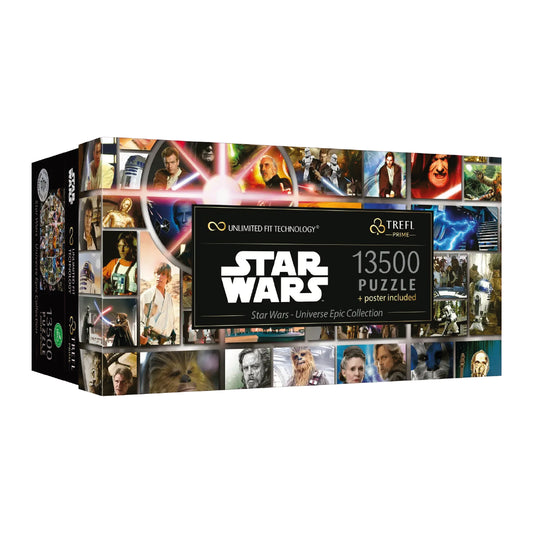


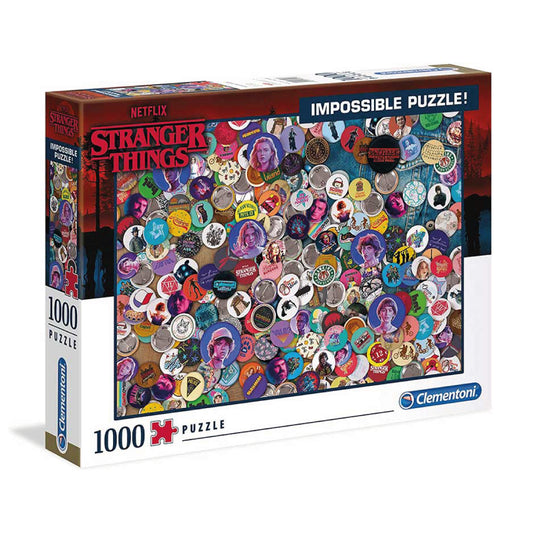
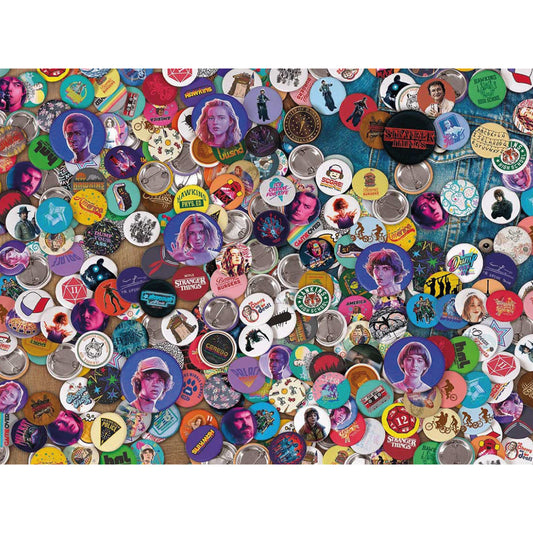


Open the box, spread the 1000 pieces across the table, and watch a gallery of villains emerge, piece by piece. There's a very particular pleasure in this panorama: the elongated format, the intense faces, the bold contrasts, and that focused silence that fills the entire room. It's not always easy. And that's the beauty of it.
Why the widescreen format with villains grabs attention.
The panorama creates a horizontal narrative. The characters look at each other, exchange intentions through their gaze, and draw well-defined blocks of color. Deep black, saturated purples, acid greens, metallic sheens in the embellishments. The theme works in our favor: each villain has a distinct palette and a unique visual texture, which facilitates segmentation.
The challenge doesn't disappear. In the center of the panel, dark tones converge and the transitions are subtle. The temptation is to leave the "sea of black" for the end. It works, but you might lose the rhythm. It's better to alternate: a group of predictable pieces, then a handful of seemingly impossible pieces, and back to something lighter. This back and forth keeps the focus without saturating.
The long format calls for a wide table. And it invites moments of contemplation, because the eye travels across the image from one end to the other. Each small movement alters the visual balance of the whole.
In short: the panorama amplifies the drama of the villains and gives you room to breathe between complex areas and zones of obvious colors.
The assembly experience that Clementoni provides
The quality of the cut dictates the pace. Well-pressed pieces, with consistent thickness and a clean fit, reduce false positives and avoid the frustration of seeing blocks crumble with a touch.
The matte print, without harsh glare, protects color readability under strong light. You can see the texture of the fabric in the garment, the contour lines, the controlled sparkle in the eyes. The image gains depth without any bothersome reflections.
The materials matter. High-density recycled cardboard resists warping, the corners don't crumble, and the pieces retain their shape after assembly and disassembly. The tactile feel is firm, with a slight roughness that helps with gripping without slipping.
Small details make all the difference. Bags that minimize dust, centered parts for proper fit, varied cutouts to avoid repetition. The result is a safer assembly and a fit that, when it happens, leaves that immediate feeling of "this is it".
Technical specifications and what that means in practice.
| Specification | What does this mean in practice? |
|---|---|
| 1000 pieces | Sessions lasting 8 to 15 hours in total, depending on the pace. |
| Panoramic format | Generous dimensions, continuous image, and horizontal reading. |
| Assembled dimensions | ~98 x 33 cm |
| Matte finish | Less reflection, more useful contrast. |
| Dense recycled cardboard | Stable parts, without warping or crushed corners. |
| Precision cutting | Clearer fit and fewer mistakes in dark areas. |
| Palette of intense colors | Visual segmentation facilitated by color blocks. |
| Villains theme | Striking features, strong expressions, defined contours. |
| Age recommendations | From the age of 14, without preventing families from participating. |
| Assembly and frame | The 100 x 35 cm inner frame provides a comfortable margin. |
Strategy for 1000 panoramic pieces
A solid approach saves hours. It begins with a generous, but not obsessive, sorting: borders to one side, pieces with eyes and faces to another, props and distinct patterns in a third group. The central part, with shadows and backgrounds, is temporarily placed on a fourth hill.
Work in islands. Face to face, shoulder to shoulder, and then the areas that touch by contrast: the purple that clings to the green, the black that cuts into the red. Assemble small blocks and place them against the frame when it makes sense, without forcing it.
Light is an ally. Diffused light from above eliminates reflections and preserves contrast between blacks. A lamp with a neutral temperature avoids chromatic aberrations. And don't underestimate rest: there comes a point when the eyes "go blind" and stop recognizing patterns; a 10-minute break restores clarity.
Below is a set of tactical points that resolve 80% of impasses:
- Suitable table : minimum surface area of 120 x 50 cm to assemble as desired and create islands around it.
- Lighting : neutral white light, coming from above, without harsh shadows on the pieces.
- Initial sorting : edges to one side; faces and eyes grouped together; clothing and prop patterns in separate piles.
- Black management : separates by cut type, not color; searches for micro textures and residual shine.
- Disciplined rotation : when testing a dark piece, rotate in 90-degree increments; this avoids random attempts.
- Short breaks : 5 to 10 minutes every 50 minutes, standing and away from the table, to regain focus.
This discipline doesn't stifle spontaneity. On the contrary, it creates conditions for moments of accurate intuition.
The social element that breathes new life into the puzzle.
A panorama of villains demands an audience. Assembling in pairs or in groups creates its own rhythm. Those with an eye for detail take on the faces. Those who are patient with patterns play with capes and textures. There's room for everyone.
Setting small, shared goals works: closing two faces before dinner, connecting the left edges to the center, attacking that electric green together. Celebrating micro-victories is part of the charm.
Simple ideas to transform an ordinary night into a memorable one:
- Themed session with a soundtrack of classics.
- Timed relays of 15 minutes
- Friendly competition to see who can close the next face.
- Auxiliary table with sorting trays.
- Timelapse photo of the evolution.
Not everything needs rules. Sometimes the best idea is to talk, laugh at failed attempts, and let the image emerge without rushing.
When the image fits: glue, frame, and care.
Some jigsaw puzzles simply need framing. This one is one of them. Those who want to preserve the puzzle can use jigsaw puzzle glue, applied with a soft spatula from the center outwards. The glue's matte finish maintains a natural, shine-free appearance.
Before gluing, take a high-resolution photo. It's a record worth keeping. If you prefer not to glue, a felt mat with a rigid tube allows you to roll it up and store it without stress. The corner pieces won't complain, and your progress remains untouched.
For the wall, you're looking for a 100 x 35 cm inner frame with a thin passe-partout. Anti-reflective glass is helpful in brightly lit rooms. It prevents walls from becoming damp and areas exposed to direct sunlight, so as not to lose saturation over the months.
An elegant alternative is to use reversible adhesive tape on the back to attach the design to a cardboard base and fit it onto a magnetic board. This gives you the freedom to change the image whenever you want.
Mental training, focus, and that rare state of alertness.
Creating villains with a challenging look requires concentration. It involves training in visual memory, pattern recognition, and tolerance for ambiguity. What seemed impossible at 7 PM becomes obvious at 8:15 PM. The brain adapts when the hand and eye gain vocabulary.
Planning short, consistent sessions is more sustainable than marathons. Two 45-minute blocks, with a break in between, can easily fill an entire afternoon, albeit with some bumps along the way. And the satisfaction of finding the right piece after a brief roadblock is priceless.
Those looking to measure their effort can record times by area: faces, props, background. On average, 10 to 14 hours is enough for someone with moderate practice, although the pace depends heavily on the method and available light. Some people enjoy and stretch it out over several evenings, which makes perfect sense.
The beautiful part is that the process improves in other compositions. What you learned about shadows and contours here transfers to landscapes, maps, or urban scenes.
Common pitfalls and how to avoid them.
Although it's an honest puzzle, there are blind spots that they repeat across many tables. Recognizing them cuts the way.
- False lines in dark areas : always confirm the continuity of the print at the micro-joints; if the line breaks, do not force it.
- Treacherous monochrome : uses the texture of the card and residual shine to distinguish different shades of black.
- Confusion at the edge : shapes the frame in segments and marks the corners with discreet sticky notes.
- Excessive sorting : if you've spent 30 minutes just separating, start assembling; the puzzle becomes clearer with the pieces in place.
- Small table : create trays with box lids; gaining 20 cm of space changes everything.
Taking a step back and changing the rules of the game for 10 minutes, a lot of things fall into place again.
A design object, a story on the wall.
The villains have presence. They look you straight in the eye with confidence, irony, a touch of elegance. Hanging the panorama on a work wall or hallway sparks conversation and reveals something about who lives there. It's a wordless statement.
It also makes you want to create series. The panorama attracts panoramas: heroes, movie scenes, night landscapes. The house gains beautiful scars of time well spent.
And when you go back to the box, you might notice details you hadn't seen before. A glint in your eye, a hidden texture, an almost invisible piece that now calls your name.