




Some toys go out of style, while others stand the test of time. Educational puzzles are in the latter group. They combine the pleasure of solving a challenge with clear benefits in cognitive, social, and motor development. And they do so without fuss, without rushing, with focus.
When chosen well, puzzles become moments of shared concentration, conversation, and curiosity. At home, at school, or in therapy, they adapt to the child's pace and grow with them.
Why invest in educational puzzles?
Puzzles are a subtle ally in learning. They develop skills that transfer to reading, writing, math, and self-regulation.
- Sustained attention and impulsivity control
- Working memory and planning
- Visual perception and spatial reasoning
- Language, categorization and vocabulary
- Fine motor skills and hand-eye coordination
- Persistence, frustration tolerance and self-concept
There's more. Puzzles encourage cooperation, conversation, and shared strategies. And they help adults observe how children think.
Puzzle Types by Age and Skill
Not all challenges are suitable for all levels. The key is to match the level of difficulty with maturity and interest. The following table can serve as a quick guide.
| Puzzle type | Suggested age | Main skills | Common materials | Typical duration | Challenge level |
|---|---|---|---|---|---|
| Large parts with pins | 18m to 3 years | Seizure, appointment, correspondence | Wood, foam | 5 to 10 min | Low |
| Shape and shadow snapping | 2 to 4 years | Visual perception, colors, shapes | Wood, cardboard | 10 to 15 min | Low to medium |
| Jigsaw 12 to 48 pieces | 3 to 6 years old | Spatial reasoning, sequence, attention | Cardboard, wood | 10 to 25 min | Average |
| Tangram and polyominoes | 5 to 9 years old | Geometry, mental rotation, creativity | Wood, felt | 15 to 30 min | Medium to high |
| Logic with guided challenges | 5 to 10 years | Deduction, hypothesis testing, strategy | Plastic, magnetic | 15 to 20 min | Progressive |
| 3D and architectures | 7 to 12 years old | 3D visualization, patience, motor skills | Foam, cardboard | 20 to 45 min | High |
| Word and number puzzles | 6 to 12 years old | Vocabulary, spelling, mental calculation | Letters, paper | 10 to 20 min | Variable |
| Mechanical puzzles | 8 to 14 years old | Engineering, trial and error, planning | Metal, wood | 15 to 40 min | High |
| Ad-free guided digital | 5 to 10 years | Sequencing, patterns, logic | Tablet, PC | 5 to 15 min | Adjustable |
The table opens doors. What will make the difference is choosing topics that speak to the child.
How to choose without getting lost
A smart purchase saves time and avoids frustration. Focus on these criteria.
- Safety and materials: robust parts, non-toxic paints, rounded edges
- Number and size of pieces: the smaller the piece, the greater the challenge and motor demand
- Autocorrect: Puzzles that provide visual clues prevent prolonged blocking
- Progression: sets with 3 to 5 levels extend the life of the product
- Interest: themes that match the current era, from dinosaurs to maps
- Available time: short games for busy days, long builds for weekends
- Storage and transportation: zip bags, small boxes, magnetic trays
- Inclusion: strong contrasts, textures, symbols, visual instructions
- Cost per use: prefer a puzzle that comes off the shelf every week
A simple rule helps: 70 percent success, 30 percent challenge. It keeps you motivated and drives growth.
Skills that come to life
Puzzles offer more training than meets the eye. Some practical examples.
- Language and literacy: naming pieces, describing positions, creating stories with the set scene
- Math: counting pieces, grouping by shapes and colors, comparing sizes, working with fractions in tangrams
- Executive functions: breaking a task down into steps, adjusting strategy when it doesn't work, managing time
- Visuospatial cognition: locating corners and edges, recognizing patterns, mentally rotating pieces
- Social-emotional: managing frustration, asking for help, offering clues, celebrating progress
A good conversation enhances all of this. Open-ended questions work wonders.
Examples of questions that unlock thinking
- What's still missing here in the right corner
- If you rotate this piece, which way do you think it fits?
- What clues do you see in the colors or lines of the image?
- It's worth looking for edges or another strategy first.
- How would you know it's perfect without forcing it?
Short questions. Time to think. And intentional silence.
Five formats that never disappoint
-
Progressive Card Puzzles
Three to six puzzles in a box, from simplest to most complex. Great for building confidence and making progress visible. -
Logic with challenges and solutions
SmartGames and similar programs offer graduated challenge books with clues and solutions. They allow for independent work and immediate feedback. -
Map puzzles
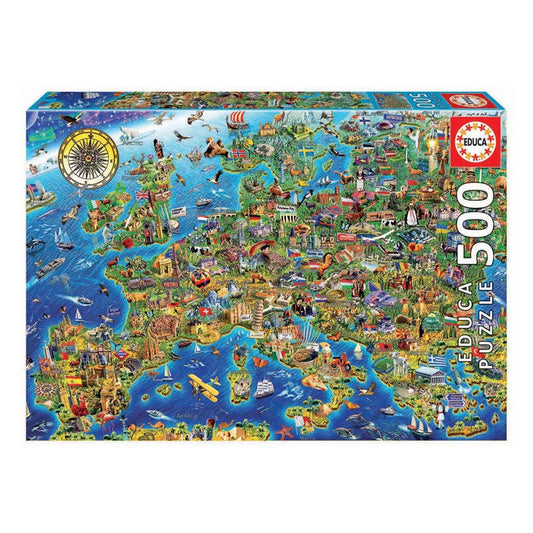
Portugal, Europe, the world. They enhance geography, orientation, and general culture. District- or country-shaped pieces increase the challenge. -
Tangram and polyominoes
Geometry in action. The same piece can create dozens of silhouettes, stimulating creativity and flexible thinking. -
Mechanical and disassembly
Padlocks, metal interconnections, and snake cubes are excellent for training patience and engineering reasoning.
Game variations to keep things fresh
- Cooperative racing: everyone against the clock, each with a clear task
- Two fronts: split the image into halves and swap in the middle
- Clue Hunt: Hiding pieces around the house with cards indicating directions
- Narration: making up a story as the image takes shape
- Mute mode: communication only with gestures, absolute focus on visual attention
- Controlled mixing: combine 2 similar sets and separate them by attributes
Small changes, big impacts on motivation.
Integration into daily life and curriculum
In the living room, at the after-school center, or in your bedroom, consistency counts. Schedule 10 to 20 minutes, 3 to 5 times a week. Short, frequent, and enjoyable.
- Mathematics: patterns, symmetries, rotations, partitions
- Languages: process description, step-by-step instructions, thematic vocabulary
- Science: water cycle puzzles, simplified anatomy, food chains
- Arts: mosaics, mandalas, construction of compositions
- Citizenship: maps, professions, road signs, ecosystems
Use a challenge journal. Recording strategies gives language to thoughts and celebrates progress.
Trusted brand suggestions and resources
- Djeco and Janod: attractive visuals, solid materials
- Haba: sturdy wood, shapes for small hands
- Ravensburger: precise cutting and realistic images
- SmartGames: logic with clear progression and solutions
- Orchard Toys: Focus on Early Literacy and Numeracy
- Ad-free and offline apps: Thinkrolls, Lightbot Jr, Busy Shapes
No affiliation. Just options that tend to work in home and school settings.
Adaptations for different profiles
Every child brings a rhythm. Adjust with intention.
- ADHD: shorter sessions, board with margins, visual timer, immediate reinforcement
- Autism: predictability, visual instructions, special interest topics, reduce visual stimulation when necessary
- Dyslexia: Non-verbal or clear typographical puzzles, clean capitals
- Visual difficulties: high contrast, large parts, tactile references
- Fine motor skills: large pegs, magnetic pieces, non-slip mat
- High skills: increase complexity, introduce self-imposed goals and rule variations
Close monitoring and specific feedback make all the difference.
DIY: Building puzzles at home
Creating instead of buying brings the child closer to the process and increases the symbolic value.
- Recycled cardboard: print a meaningful image, glue it to thick cardboard, laminate it with wide adhesive tape, and cut it into pieces
- Felt Tangram: Cut with mold, allows you to play on slippery surfaces and is silent
- Magnetic maps: magnetic glue behind the pieces, refrigerator door as a tray
- Popsicle sticks: line up 8-10, tape them together, paint a scene, cut and mix
- Recipes in steps: cards with photos of each step, classify and execute
- Unplugged Logic: Sequence Cards with Shapes and Colors, Simple Rules, and Progression
Safety first. Suitable paints, large pieces for young children, active supervision.
Common mistakes and how to avoid them
- Difficulty mismatch: Reduce the number of pieces or provide gradual clues
- Over-helping: Allow attempts, ask before intervening
- Lack of routine: schedule a short, regular schedule
- Vague Reinforcement: Praise the Strategy, Not Just the Outcome
- Monotony: Rotate themes and formats, insert rule variations
Small tweaks put the experience back on track.
Feedback strategies that increase autonomy
Replace generic phrases with observations that reflect the process.
- I saw you looked for the corner pieces first
- When it didn't work, you rotated the piece and tested another hypothesis.
- You kept your attention even when there was little left
- Did you notice the lines that cross the image?
Talking about processes builds metacognition.
Managing frustration without erasing desire
Frustration is part of training. The goal isn't to avoid it, it's to make it manageable.
- Help scale: 1 visual cue, 1 question, 1 short demo
- Intentional breaks: breathe, move, drink water, come back with fresh eyes
- Normalizing Error: Sharing That Adults Test, Fail, and Adjust Too
- Celebrating effort: recording time invested and strategies used
The pleasure of overcoming an obstacle speaks louder when the child feels in control.
Puzzles and Technology: When It Makes Sense
Well-designed digital resources can train patterns, sequences, and logic with immediate feedback. Pay attention to three criteria.
- No ads or data collection
- Short sessions with clear objectives
- Transfer to real-world physical activities
Technology adds value, it doesn't replace working with your hands.
Frequently asked questions
When is the best time to start?
Between 18 and 24 months, with simple, large inserts. Before that, matching toys and permanence boxes will do the trick.
How long should each session last?
Between 10 and 20 minutes for preschoolers, 15 to 30 for elementary school children. Complete successfully, even if partially.
How to choose the number of pieces
Rule of thumb: child's age multiplied by 10 gives a flexible ceiling, adjusting to profile and experience.
What if the child avoids puzzles
Start with high-motivation topics, make the task social, reduce the difficulty, and introduce playful variations.
Competition or cooperation
Cooperation encourages shared language and strategies. Use light competition only to motivate and never humiliate.
When to move to 3D
When jigsaws with 100 to 200 pieces stop being challenging and the child shows a taste for construction.
How to save and maintain
Zippered bags, labeled boxes, and a photograph of the results for reference. Wipe with a damp cloth and air dry.
Repetition makes sense
Yes. Fluency is built through repetition. Introduce small twists to maintain interest.
What is the difference between a puzzle and a logic game?
Many puzzles are static with a clear end result. Logic games offer multiple, evolving challenges with stable rules.
Recommended progression sequences
For 3 to 6 years old
- Shape and shadow fittings
- Jigsaw 12 to 24 pieces with simple outline
- Progressive puzzles with 4, 6, 9 and 12 pieces
- Introduction to tangram with templates
For 6 to 9 years old
- Jigsaw 100 to 200 pieces
- Logic with graduated challenges
- Free tangram and polyominoes
- Maps with country-shaped pieces
For 9 to 12 years old
- 3D foam or cardboard, 200 to 500 pieces
- Disassembly mechanics
- Number puzzles, accessible cryptograms
- Themed architectures and detailed maps
The rhythm decides. The progression is not linear, it is responsive.
Quick ideas for classroom and therapy
- Rotating Stations: 4 tables, 4 puzzle types, 8 minutes per station
- Visual diary: before and after, with photos and notes on the strategy applied
- Pair binomial: one explains, the other executes, alternating every 3 minutes
- Clue Box: Graduated Self-Help Clue Cards
- Self-Assessment Rubric: Focus on Effort, Strategy, and Collaboration
Simple structures create solid mental habits.
A mini-attention lab at home
Set aside a quiet corner, good lighting, a low shelf, and trays. Less is more. Three visible options are enough.
- A familiar puzzle to warm up
- A new challenge set
- A different format to break the routine
Weekly rotation and a calendar with stickers seal the commitment.
Signs that you are at the point
- The child asks to repeat without external insistence
- Focus time increases without complaints
- Strategies become more varied
- The help needed decreases
- Pride is visible in the body and in the smile
This is where habit sets in.
Quick checklist to get started today
- Define the objective: focus, language, math or motor skills
- Choose level: 70 percent success, 30 percent challenge
- Prepare the environment: light, relative silence, stable surface
- Establish a routine: 10 to 20 minutes, 3 to 5 times a week
- Have a three-step help plan
- Record processes with two specific phrases per session
- Celebrate effort with a simple gesture
There's always an honest challenge tailored to each child. The next puzzle could be the trigger for a lifelong skill.